
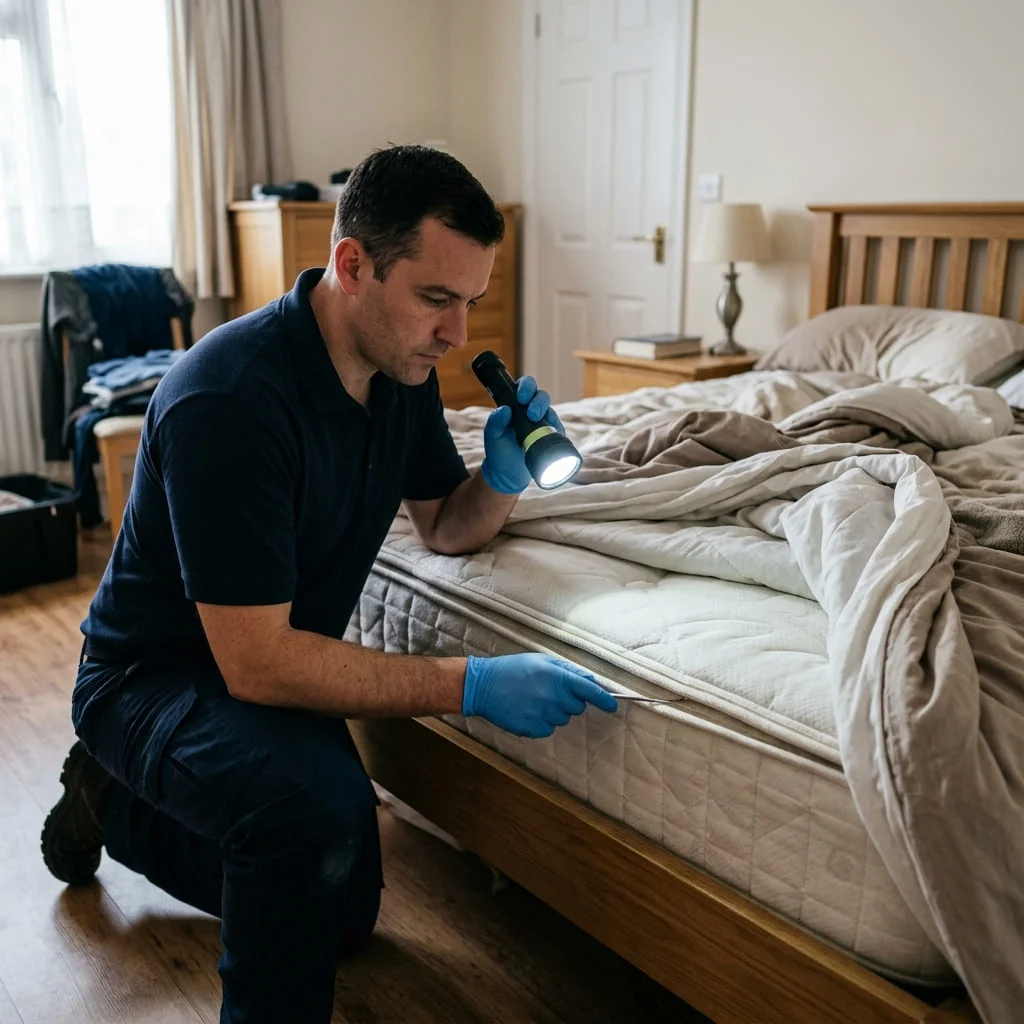
A professional bed bug inspection in Washington costs $75 to $200 for a visual sweep and $300 to $600 for a certified canine team, and it is the only thing that turns a guess into a quote. Technicians work a documented map of roughly 20 locations per room, because bed bugs spend about 95% of their time hidden and the obvious places are rarely the only ones. This page covers what each method detects, what your report should say, and when a free inspection is worth taking.
Visual versus canine: what each one actually detects
Visual and canine inspections detect different things, and the common assumption that dogs are simply better is too crude. Each has a job.
A visual inspection finds physical evidence: live insects, shed skins, eggs, and the dark faecal staining along seams that is usually the first confirmable sign. Its strength is that everything found is verifiable — you can photograph it and put it in a report. Its weakness is time and access. A technician cannot open every wall void, and a light infestation in a cluttered home can hide from a careful hour of looking.
A canine inspection detects the scent of live bed bugs and viable eggs, which means it can flag an active infestation that has left almost no visible trace. Speed is the real advantage: a dog clears a hotel floor or an apartment stack in the time a technician would spend on two rooms. The limitation is that an alert is not evidence on its own. Dead insects, old staining and residual scent can all trigger one, so a good handler confirms alerts visually before anything is written down.
The 20-point inspection map
The inspection map below is roughly what a competent technician works through per room, in the order they work it. Bed bugs concentrate within about six feet of where a person sleeps, so the sequence moves outward from the bed rather than around the room.
01 The bed
- Mattress seams, piping and tufts
- Box spring underside and the fabric dust cover
- Bed frame joints, bolt holes and slats
- Headboard back and its wall mounts
- Pillows and pillow seams
02 Within six feet of the bed
- Nightstand drawers, runners and undersides
- Dresser joints and drawer backs
- Upholstered chair seams and skirts
- Baseboards and the carpet tack strip edge
- Under and behind the mattress protector
03 The room shell
- Electrical outlet and switch plates
- Curtain hems, rod ends and window casings
- Picture frames, mirrors and wall art backing
- Door hinges, frames and strike plates
- Carpet edges where they meet the wall
04 Everywhere else people miss
- Sofa seams and under sofa cushions in living rooms
- Luggage, backpacks and their storage location
- Smoke detector and light fixture housings
- Loose or peeling wallpaper and trim
- Shared walls and adjoining units in multi-family buildings
What a written inspection report must contain
A written inspection report is the document you will rely on if this becomes a dispute with a landlord, a tenant, an insurer or a buyer, so the standard is higher than a quote on a clipboard. Insist on all six of the following.
- Date, time and inspector identification, including the licence held and, for canine work, the team's certification.
- Every room inspected, named, and every room that was not inspected, with the reason it was skipped.
- Findings by location, not a single yes or no for the property. "Live adults in master bedroom box spring seam" is useful. "Bed bugs present" is not.
- Evidence type, distinguishing live insects from shed skins, eggs and staining. Old evidence and an active infestation are different findings with different consequences.
- Photographs with location captions, dated.
- Recommended treatment and scope, stating which rooms need work and whether adjoining units should be inspected.
Free versus paid inspections, honestly
Free inspections are worth taking and worth understanding. The company offering one is bidding for your treatment job, and that is a normal commercial arrangement rather than a trap — but it does mean the person assessing severity is the person who benefits from the assessment.
A paid inspection buys independence. It makes most sense when you need a report that will be read by someone else: a landlord dispute, a purchase or lease decision, a multi-unit building where liability is in question, or a second opinion after a treatment you believe failed. In those situations, paying $150 for an inspector with no stake in the treatment contract is straightforwardly worth it.
For a homeowner who already knows they have a problem and simply wants it gone, take the free inspection, get the findings in writing, and compare two or three scopes. The cost page explains what to compare between them.
Inspection for property managers and landlords
Property managers need inspection to answer a different question than homeowners do. The question is not only "is there an infestation" but "how far has it travelled and which units do I have to act on," and in Washington that has legal consequences under RCW 59.18.060.
In multi-family buildings, inspect the reported unit plus the units above, below and either side as a minimum. Bed bugs move through shared walls, along wiring runs and via common laundry. Treating one unit while an adjoining unit stays untreated is the most expensive mistake in multi-family pest control, because the whole cost repeats in six weeks.
Canine sweeps make the economics work at scale — clearing a 40-unit building visually is not realistic, but a certified team can do it in a morning. Our apartments and multi-family page covers the obligation framing and how building-wide response is structured.