Commercial bed bug control differs from residential work in three specific ways: the inspection has to cover adjoining units, the response has to be documented, and almost every operator needs it done without anyone noticing. Washington property managers, hoteliers and care operators are usually weighing reputation and legal exposure alongside the treatment cost, and a company that only talks about price is answering the wrong question.
Discretion is a service requirement, not a favour
Discretion matters as much as price in commercial bed bug work, and it is entirely reasonable to make it a condition of the contract. A branded van parked outside a hotel for six hours communicates something to every guest arriving that afternoon, and to anyone photographing it.
Ask for unmarked or plainly marked vehicles, technicians without branded uniforms, scheduling outside guest or business hours, entry through service access, and no signage at the property. These are standard requests in commercial work. A company that finds them unusual is telling you how little commercial work it does.
Why the inspection scope decides everything
Inspection scope decides whether a commercial job succeeds, and it is where most failures originate. Bed bugs travel through shared walls, along wiring and plumbing runs, through common laundry, and on housekeeping carts. Treating the unit that complained, while the unit next door goes uninspected, produces a treated unit that gets reinfested within weeks.
The working minimum in any connected structure is the reported unit plus the units above, below and on either side. Canine detection is what makes that economically viable at scale — a certified team can sweep a forty-unit building in a morning, where a visual inspection of the same building would take days. The inspection page covers what each method detects and what a report must contain.
The five commercial settings, and what changes in each
Commercial settings vary enough that a single approach does not transfer between them. Below is what actually changes from one to the next.
Apartments and multi-family
The largest commercial category in Washington and the one with the clearest legal exposure. RCW 59.18.060 places a duty on landlords to control infestation in most rental housing, which makes response time a compliance question rather than a service-level preference. Treating a single reported unit while adjoining units go uninspected is the most expensive mistake available in multi-family pest control.
Hotels and motels
One review naming bed bugs outlasts any refund you issue. Hotel response has to be fast, quiet and documented: pull the room from inventory, inspect the rooms either side and directly above and below, treat, and re-inspect before it goes back on sale. Along the I-5 and I-90 corridors, where turnover is high and guests arrive from everywhere, quarterly canine sweeps cost less than a single sustained reputation problem.
Student housing and dorms
August and September move-in drives a predictable annual spike around WWU in Bellingham, EWU in Cheney, CWU in Ellensburg, Evergreen and SPSCC around Olympia and Lacey, and the Seattle and Tacoma university cluster. Second-hand furniture and thousands of suitcases arriving in one week is the mechanism. Buildings that sweep before move-in rather than after the first complaint spend a fraction as much.
Senior living and assisted care
The hardest setting to treat well, and the one where a standard approach fails. Residents may be unable to vacate for the eight hours heat requires, oxygen equipment and medication storage constrain what can be done, and reduced sensitivity means bites are often noticed late. Treatment plans here have to be built around the residents rather than the calendar, which is exactly the conversation to have before signing anything.
Airbnb and vacation rentals
Short-term rental hosts carry hotel-level exposure with none of the operational buffer. A single guest report can suspend a listing, and turnover between guests leaves almost no window to treat. Leavenworth, Chelan, Ocean Shores and Long Beach see concentrated seasonal risk. Interceptors under every bed and a documented between-stay check are the cheapest insurance available.
Choosing method in an occupied building
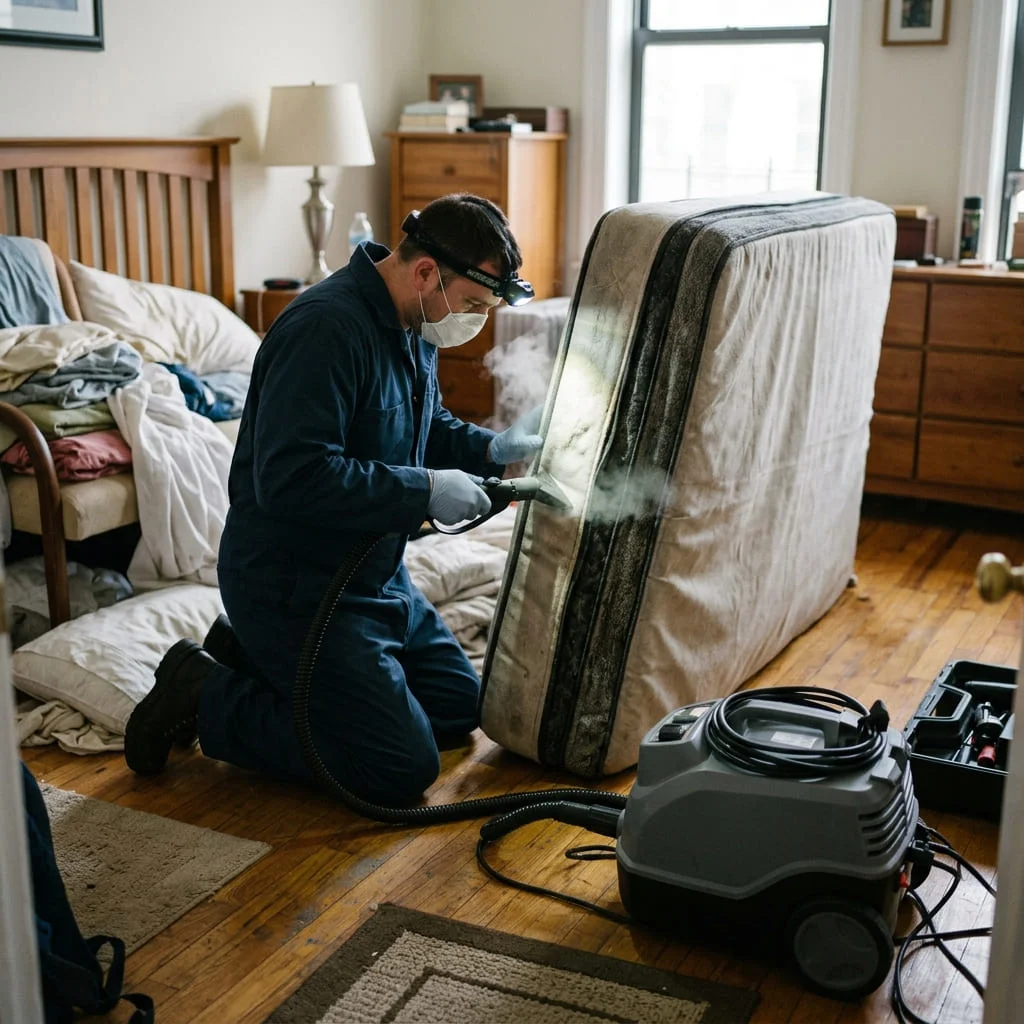
Method choice in an occupied building is constrained by occupancy more than by infestation severity. Heat is the stronger treatment because it kills eggs in one visit, but it requires a unit to be empty for six to eight hours, which is straightforward for one apartment and unworkable for a whole floor simultaneously.
Chemical programmes suit connected occupied properties because units can be treated on a rolling schedule without emptying the building. The trade-off is the return visits — two to three per unit, timed around the egg hatch — and the coordination that implies across a stack of apartments. Many commercial jobs end up combined: heat for the worst units, chemical for the surrounding buffer. The heat treatment page covers where thermal work is and is not appropriate.
What commercial bed bug work costs
Commercial pricing follows unit count rather than a flat commercial rate, and per-unit costs drop meaningfully at volume. A single apartment unit sits in the same $450 to $1,600 band as an equivalent residential job, but a building-wide programme is quoted per door and comes in well below that per unit.
Canine inspection is where the scale advantage is clearest: per-unit sweep rates across a large building are a fraction of the $300 to $600 a single-property inspection costs. Ask for pricing on inspection and treatment separately, so you can commit to the sweep without committing to a treatment scope before you know what the sweep finds. Standing contracts with scheduled sweeps generally price lower again. The cost page covers the underlying ranges.