
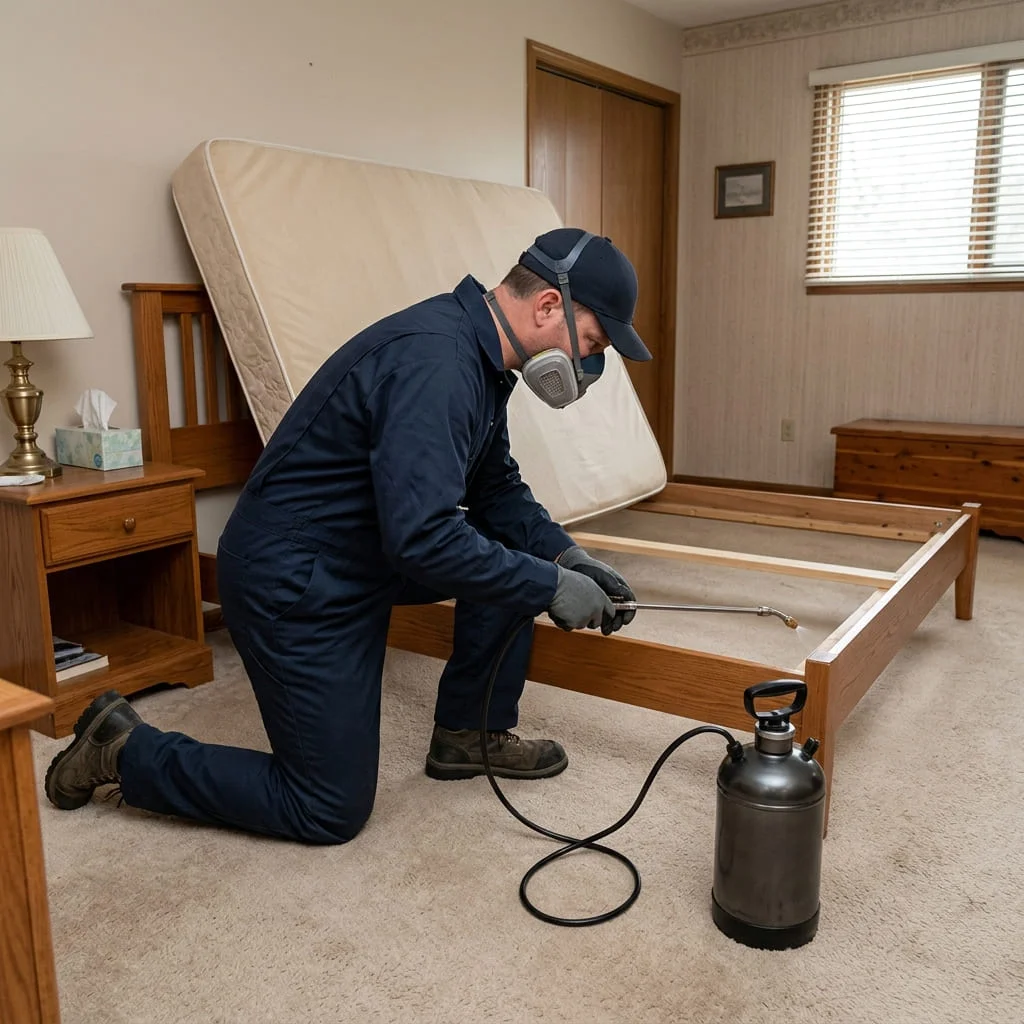
Bed bugs travel between apartment units through shared wall voids, wiring chases and corridors, which is why treating a single reported unit fails often enough to be the default outcome. The working minimum scope in any Washington multi-family building is the reported unit plus the units above, below and on either side. For landlords, RCW 59.18.060 makes response speed a compliance question as well as a maintenance one.
How bed bugs move through a building
Bed bugs move through a building along routes that were built for something else. Understanding them is what makes the inspection scope obvious rather than arguable.
- Shared wall voids. The cavity behind a shared wall is continuous, and outlet boxes on either side open directly into it. An outlet plate is the most common transit point between units.
- Plumbing and wiring chases. Vertical runs connect stacked units, which is why the unit directly above and below matters as much as the ones either side.
- Door thresholds and corridors. Bed bugs will cross a hallway, particularly once a treated unit becomes inhospitable.
- Common laundry. A shared machine room moves infestations between floors and between buildings on the same site.
- Furniture and residents. A discarded mattress dragged down a corridor seeds every unit it passes. This is why bagging in place matters.
What Washington landlords are required to do
Washington landlords carry a duty under RCW 59.18.060 to keep rental premises fit for habitation, and controlling infestation sits inside that duty for most rental housing. Once a tenant reports bed bugs in writing, the clock on a good-faith response starts — RCW 59.18.070 puts it at ten days.
The exception worth knowing, because national templates almost never mention it, concerns single-family residences. In that housing type the landlord's infestation duty applies at the commencement of the tenancy rather than continuously throughout it. That distinction changes the answer for a substantial share of Washington renters, and it is the first thing to establish before arguing about who pays.
RCW 59.18.130 sets out tenant duties, and it is the provision landlords generally rely on when arguing a tenant caused an infestation. Causation is genuinely hard to establish with an insect that arrives by hitchhiking and moves between units, so a bill asserting it should be met with a written request for the supporting evidence and the inspection results for adjoining units.
How a building-wide response is structured
A building-wide response is structured to get ahead of the spread rather than chase it, which means inspecting wider than the complaint and treating in a coordinated block.
-
First
Log the report in writing
Date the complaint, record the unit, and acknowledge it in writing to the tenant. This record is what demonstrates a good-faith response later.
-
Second
Inspect wider than the complaint
The reported unit plus the units above, below and either side, as a minimum. Canine sweeps make whole-building inspection viable — a certified team clears forty units in a morning.
-
Third
Treat as a coordinated block
Every unit with confirmed activity treated on the same schedule, with the surrounding buffer included. Rolling treatment unit by unit lets the population stay ahead of the work.
-
Fourth
Prepare tenants properly
Written prep instructions with enough lead time, and practical help for residents who cannot do it themselves. Failed prep is the leading cause of a treatment that has to be repeated at the landlord’s cost.
-
Fifth
Monitor with interceptors
Interceptors under bed and sofa legs in treated and adjacent units give an objective read on whether anything survived, rather than relying on tenants reporting bites.
-
Finally
Re-inspect and document the close
A follow-up inspection roughly two weeks after final treatment, documented per unit. Keep the whole file even once the matter appears resolved.
If you rent and you have found them
If you rent, the most useful thing you can do in the first 24 hours is create a record. Notify your landlord or property manager in writing — email is fine and timestamps itself — stating the date you first noticed evidence and describing what you actually found rather than what you think it means.
Attach dated photographs of staining, shed skins or live insects. Ask for a written response with an inspection date. Keep every reply. If you are later billed, or told the infestation is your fault, that file is the difference between a conversation and an argument you cannot support.
In the meantime, keep sleeping in your own bed rather than moving to another room, and do not use a fogger. Both instincts spread the infestation and neither is recoverable. The emergency page covers what to do tonight in more detail.
Apartment treatment cost
Apartment treatment cost runs $450 to $900 for chemical work in a studio or one-bedroom and $800 to $1,600 for heat, rising to $700 to $1,400 and $1,200 to $2,200 respectively in a two-bedroom. Building-wide programmes are priced per door and land well under those per-unit numbers.
The line item most often missing from a cheap quote is inspection of adjoining units, which is also the line item that determines whether the treatment holds. When comparing quotes, confirm how many units each one actually covers. Full ranges are on the cost page, and the commercial hub covers the other property types.