Professional bed bug removal in Washington costs $1,000 to $2,500 for a typical single-family home, and clears most infestations in either one heat treatment or two to three chemical visits. Licensed exterminators working across all 25 Washington county areas handle the full sequence: inspection, treatment, and a follow-up that confirms nothing survived. This page explains what that sequence actually involves, so you can tell a thorough quote from a cheap one.
What you are actually dealing with
What you are dealing with is an insect built specifically to survive the things people try first. Adult bed bugs are about the size and colour of an apple seed, flatten to the thickness of a credit card, and spend roughly 95% of their lives hidden in seams, screw holes, outlet boxes and the underside of bed frames. A single female lays one to five eggs a day and several hundred over a lifetime.
The timeline matters more than the numbers. Eggs hatch in six to ten days, which is precisely why a single application of pesticide so often looks like it worked for a week and then fails. Adults can survive several months without feeding, and longer in the cool conditions of an unheated Washington basement or crawlspace, so waiting an infestation out is not a strategy.
Three signs are worth more than a hundred bites. First, dark ink-blot staining along mattress piping and box spring seams, which is digested blood. Second, translucent shed skins, which look like empty casings of the insect itself. Third, live insects in the seam when you pull the fitted sheet back at 3am with a torch. Bites alone confirm nothing — plenty of people react to bed bug bites with no visible mark at all, and plenty of other things bite.
How professional bed bug removal works
Professional bed bug removal works as a sequence rather than a single visit, and each stage exists because of something the insect does. Here is the order a competent Washington company will follow.
-
First
Inspection and confirmation
A technician works the bed frame, mattress seams, headboard, nightstands, baseboards and outlet plates, and often a canine team in multi-unit buildings. The point is to confirm the species and map how far it has spread before anyone quotes a price.
-
Second
A written scope and quote
You should receive the rooms to be treated, the method, the number of visits included, what preparation you are responsible for, and the warranty length in writing. A number quoted over the phone without an inspection is a guess.
-
Third
Preparation
Laundry goes through a hot wash and a high-heat dryer cycle, clutter is reduced so treatment can reach harborage, and furniture is pulled off walls. Some companies include prep in the price and some do not, which is a common reason two quotes differ by hundreds.
-
Fourth
Treatment day
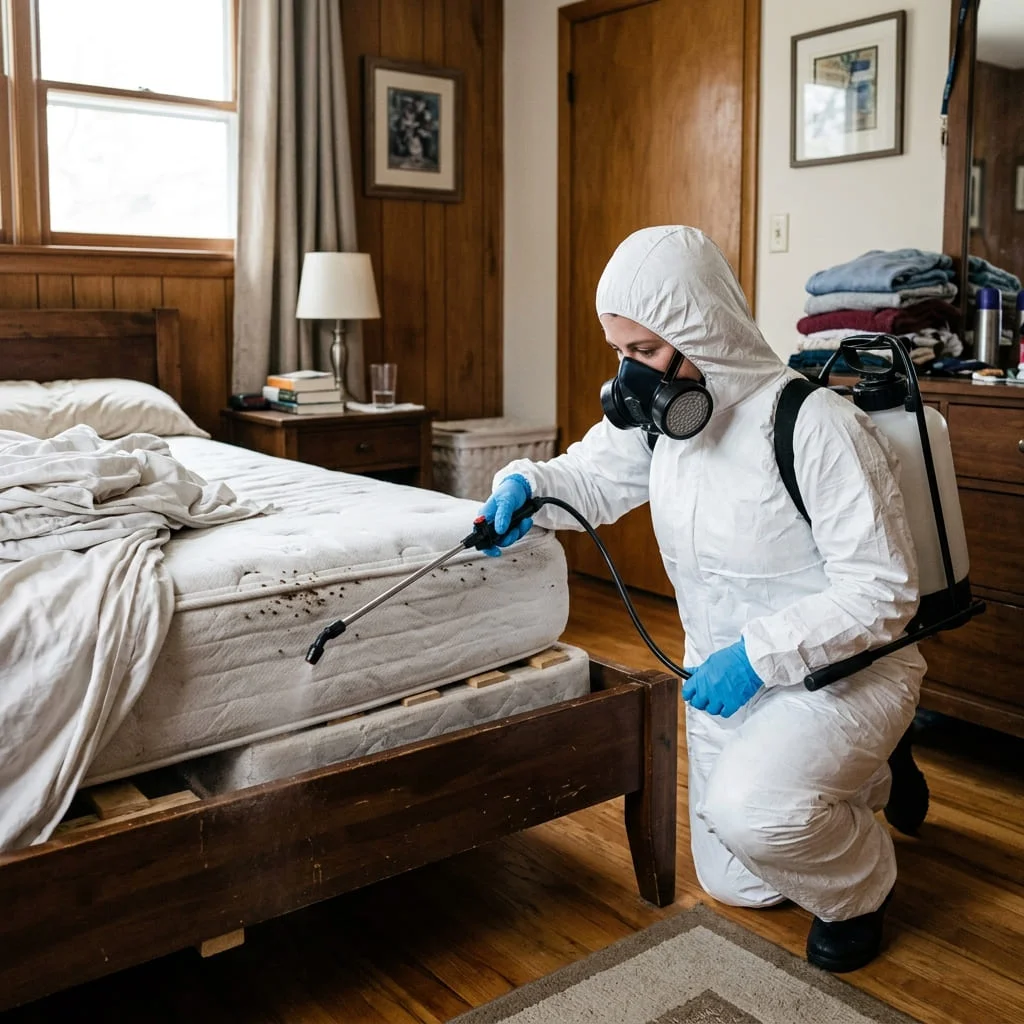
Heat brings the whole structure to a sustained lethal temperature over six to eight hours. Chemical treatment applies residuals and contact materials to harborage, and is repeated on a schedule set by the egg-hatch window.
-
Fifth
Follow-up and monitoring
Interceptors under bed and sofa legs catch anything still moving, and a return inspection around two weeks later confirms the result. Skipping this step is how a job gets called finished while a pocket survives.
-
Finally
The warranty period
Reputable companies stand behind the work for 30 to 90 days, sometimes longer with heat. Read what voids it — bringing in used furniture usually does, and so does refusing recommended follow-up visits.
Heat or chemical: how the decision is actually made
The heat versus chemical decision comes down to eggs, timeline and what is in the room. Neither method is universally better, and a company that only ever recommends one of them is telling you about their equipment rather than your infestation.
Heat raises the entire space to between 120°F and 135°F and holds it there. At 130°F and above every life stage dies, eggs included, which is the whole argument for it. One visit, no reinfestation from a hatch you missed, and one day off work instead of four. It costs more per room and it cannot be used everywhere — candles, vinyl records, aerosols, some electronics, musical instruments and certain medications have to come out first.
Chemical treatment costs less per visit and suits occupied multi-unit buildings where shutting a whole floor down is not realistic. The trade-off is the schedule. Because conventional pesticides do not reliably kill eggs, the programme is built around coming back after they hatch, which means two or three visits and four to six weeks of living with it. Pyrethroid resistance is also widespread in bed bug populations, so the material matters as much as the method.
What bed bug removal costs in Washington
Bed bug removal costs in Washington vary more than almost any other pest service, and the reason is scope rather than dishonesty. Two quotes on the same house can differ by $3,000 because one includes three visits, prep and a 90-day warranty while the other covers a single application of a residual in two rooms.
| Service | Typical range | What moves the number |
|---|---|---|
| Inspection Frequently waived if you book treatment with the same company. | $75 $200 | Frequently waived if you book treatment with the same company. |
| K9 scent detection A certified handler team. Worth it across multi-unit buildings. | $300 $600 | A certified handler team. Worth it across multi-unit buildings. |
| Chemical treatment, per room Two to three visits, spaced to catch eggs hatching at day 6–10. | $270 $775 | Two to three visits, spaced to catch eggs hatching at day 6–10. |
| Heat treatment, per room One visit. Kills every life stage including eggs the same day. | $400 $900 | One visit. Kills every life stage including eggs the same day. |
| Whole home, typical Where most Washington single-family jobs actually land. | $1,000 $2,500 | Where most Washington single-family jobs actually land. |
| Whole home, severe Heavy infestation across multiple rooms with structural harborage. | $4,000 $6,000 | Heavy infestation across multiple rooms with structural harborage. |
| Heat, per square foot Priced by area above roughly a $1,000 minimum callout. | $2.00 $6.50 | Priced by area above roughly a $1,000 minimum callout. |
| Same-day emergency A surcharge on top of the treatment cost, not instead of it. | +$200 +$500 | A surcharge on top of the treatment cost, not instead of it. |
Before you compare two numbers, make sure you are comparing the same thing. Ask each company how many visits are included, whether the price covers the whole home or named rooms, who is responsible for preparation, how long the warranty runs, and what voids it. Those five answers explain nearly every price gap you will see.
Full detail, including cost by home type and what drives each range, is on the bed bug exterminator cost page.
How fast you can get someone out
How fast someone gets out to you depends mostly on where you are and what day it is. Across the Puget Sound corridor — King, Pierce and Snohomish county areas — same-day or next-day inspection is realistic on weekdays. In the Olympic Peninsula, the coast and eastern county areas, expect one to three days, because fewer companies cover those ZIPs and travel time is real.
Same-day treatment carries a surcharge of roughly $200 to $500 on top of the job. Whether that is worth paying depends on your situation, and the honest answer is that it usually is not — one extra night changes very little about an infestation that has been building for weeks. It is worth it when you are moving out in 48 hours, when a landlord has served a deadline, or when someone in the home is reacting badly. The emergency treatment page covers what same-day realistically means and what to do in the hours before a technician arrives.
What happens if they come back
If bed bugs come back after treatment, the cause is almost always one of four things, and knowing which one tells you whether you are owed a free return visit. Understanding the difference between a treatment failure and a fresh introduction is the difference between a warranty claim and a new job.
- An egg hatch the schedule missed. Activity at day eight to fourteen after a single chemical visit is not a new infestation. It is the reason the second visit exists.
- Untreated harborage. A room that was skipped, an adjoining unit, or a piece of furniture that was not opened up.
- Resistance. If a pyrethroid was used and the population shrugged it off, the material needs to change, not the dose.
- Reintroduction. Used furniture, a suitcase, a neighbouring unit in a multi-family building. This one is usually not covered by a warranty, which is why the fine print matters.
Seeing a single insect three weeks after treatment does not mean the job failed. Seeing fresh staining, live insects across multiple rooms, or bites resuming on a nightly pattern does. Call the company back before the warranty window closes, and ask for the follow-up inspection in writing.
Renters and homeowners are in different positions
Renters and homeowners face the same insect and completely different problems. If you own the home, the decision is yours and the cost is yours, so the work is comparing scopes and choosing a method.
If you rent in Washington, the relevant law is RCW 59.18.060, which places a duty on landlords to control infestation in most rental housing. The exception almost nobody mentions is that in single-family residences that duty applies at the start of the tenancy rather than during it, which changes the answer for a large share of Washington renters. RCW 59.18.130 covers the situations where a tenant can be held responsible, and the guide to who pays works through both.
Whatever your situation, notify your landlord in writing rather than by phone, date it, describe what you found rather than what you suspect, and keep a copy. Photographs of staining and shed skins with a date stamp are worth more than a description later — there is a template letter and a documentation checklist in the guides.
Where we cover
Coverage runs across 474 Washington ZIP codes in 25 county areas. The metros below carry the deepest availability, and the full service area directory lists every county area and city we can route a job to.
Largest metros
- Seattle
- Tacoma
- Spokane
- Vancouver
- Bellevue
- Everett
- Renton
- Kent
- Federal Way
County areas served
- Rural / Other
- King
- Pierce
- Spokane
- Snohomish
- Grant
- Kitsap
- Skagit
- Whatcom
- Clark
- Lewis
- Cowlitz
- and 13 more →