
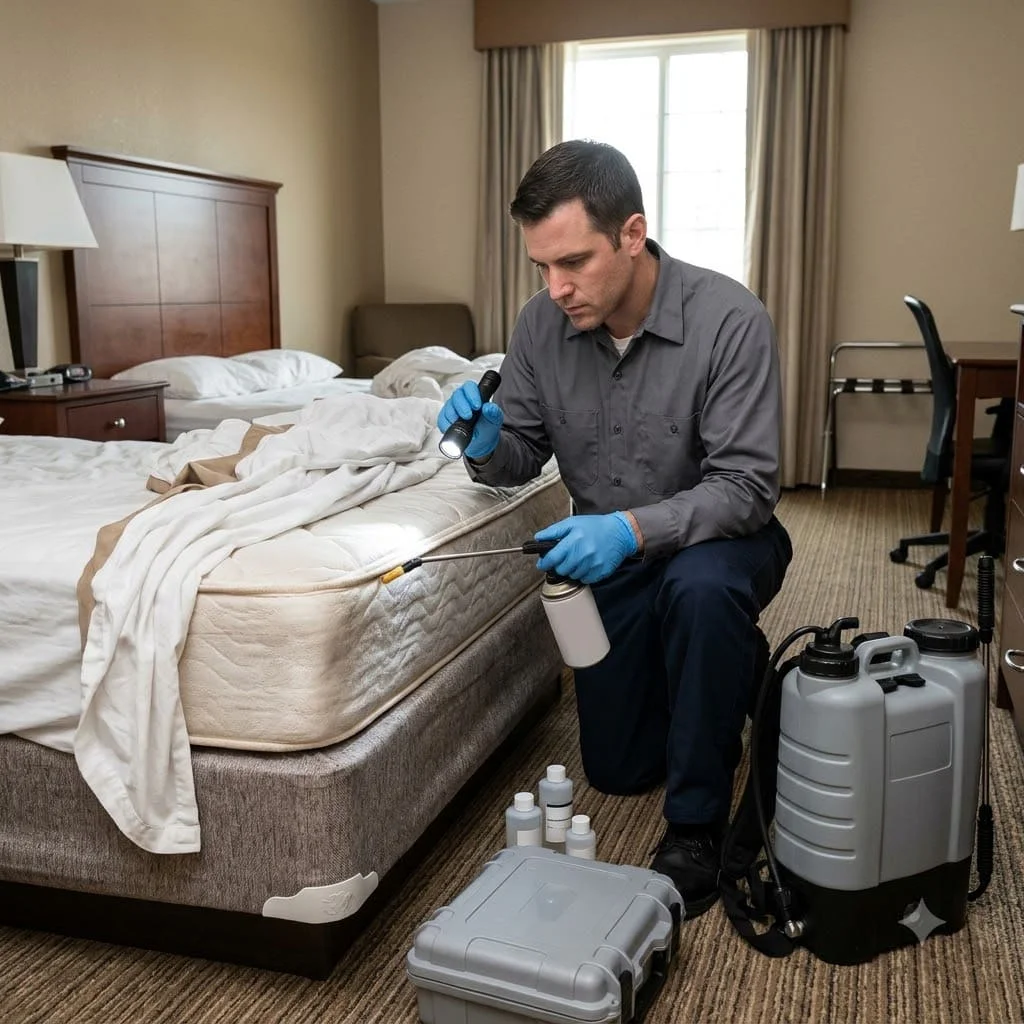
For a hotel, the treatment is the cheap part. The expensive part is the review, and a review naming bed bugs stays on the first page of your property's search results long after the room has been cleared. That asymmetry is what should drive the response: fast enough that the guest is dealt with before they post, wide enough that the same floor does not report again in a month, and documented well enough to stand up if anyone later asks what you knew.
The first hour after a guest reports
What staff do in the first hour decides how expensive the incident becomes, and most of the instinctive responses make it worse.
- Move the guest, but not next door. Relocating them to the adjoining room puts them in the room most likely to be affected next. Move them to a different floor or wing.
- Do not send their luggage with them untreated. This is how one room becomes two. Bag it, and offer to have it heat treated — most properties that have been through this once keep a heat chamber or have an arrangement for it.
- Take the room out of inventory immediately and block it in the system, so nobody sells it while an inspection is pending.
- Do not clean it. Stripping the bed and vacuuming destroys the evidence an inspector needs and disperses insects into the corridor. Housekeeping should be told explicitly, because their training says the opposite.
- Photograph and date everything the guest found, plus the room and the bed. This file is the record that matters later.
Why the scope is never one room
Bed bugs do not respect a room number. They travel along shared wall voids and through the outlet boxes that open into them, up and down wiring and plumbing chases between stacked rooms, and under doors into corridors — particularly once a treated room becomes inhospitable.
So the working minimum scope in any hotel is the reported room plus the rooms either side, directly above and directly below. The housekeeping cart adds a route the building plan does not show: linen, vacuum heads and the cart itself move between rooms all day, which means the rooms served by the same cart in the same week are worth inspecting even when they are nowhere near the report.
This is where canine detection earns its cost in hospitality. A certified team can sweep a mid-size property in a morning, where visual inspection of the same building would take days and still miss early-stage activity. The inspection page covers what each method actually detects and what a written report should contain.
The response sequence
A hotel response is structured to get the room back into inventory quickly without leaving a problem behind it.
-
First
Block the room and inspect within 24 to 48 hours
Same-day inspection carries a surcharge and is often worth it in hospitality, because every day the room is blocked is revenue and every day the infestation runs is scope.
-
Second
Inspect the surrounding block, not just the report
Either side, above, below, and the rooms the same housekeeping cart served. Findings here decide whether this is a one-room job or a floor job.
-
Third
Treat — usually with heat
Heat clears a room in one visit including eggs, which is why hospitality pays the premium for it. The room is sellable that night rather than after a month of chemical visits.
-
Fourth
Install interceptors before the room reopens
Interceptors under bed and sofa legs give an objective read on whether anything survived, without waiting for another guest to be the detection method.
-
Fifth
Re-inspect at roughly two weeks
Documented per room. This is the step that closes the file, and the one most often skipped when a property is busy.
-
Finally
Train housekeeping on what to look for
Staff strip every bed in the building daily. A twenty-minute briefing on staining and shed skins turns that into the cheapest detection layer a property has.
Washington's corridor risk
Risk in Washington lodging concentrates along the routes that carry the most transient traffic. The I-5 corridor from Vancouver through Kelso, Centralia, Olympia, Tacoma, Seattle and Everett to Bellingham runs the highest turnover in the state, and properties on it take guests from everywhere.
I-90 east through Ellensburg, Moses Lake and into Spokane carries the same pattern at lower volume. Airport-adjacent properties around Sea-Tac see luggage that was in an aircraft hold hours earlier, and tourist-season lodging in Leavenworth, Chelan, Ocean Shores and Long Beach concentrates a year's turnover into a few months.
None of that makes an infestation likely in any given room. It does mean that at property scale, over a year, the question is when rather than whether — which is the argument for a scheduled sweep rather than a complaint-driven one.
Discretion is a contract term
A branded pest control van parked outside a hotel for six hours communicates something to every guest arriving that afternoon and to anyone with a phone camera. Treat discretion as a condition of the work rather than a favour to ask for.
Reasonable and standard requests: unmarked or plainly marked vehicles, technicians without branded uniforms, entry through service access rather than the lobby, scheduling outside check-in and check-out peaks, and no signage anywhere on the property. A company that finds these unusual is telling you how little hospitality work it does. The commercial hub covers the same requirement across the other property types.
What it costs, and what a sweep costs
A single guest room runs roughly $400 to $900 chemical and $700 to $1,500 for heat. Hospitality generally pays for heat, because a room cleared in one day and sold that night is worth more than the saving on a chemical programme that blocks it for weeks.
Quarterly canine sweeps are quoted per room and land far below the $300 to $600 a single-property inspection costs, because the cost is in mobilising the team rather than in the rooms. Set against one sustained reputation problem, a year of sweeps is inexpensive. When comparing bids, confirm the room count covered and whether re-inspection is included — those two lines explain most of the spread between quotes. Full ranges are on the cost page.
Call us and we will get an exterminator who covers your area out to the property. Guests who have found bed bugs in a room should read the hotel guide, which covers what to do that night and before going home.