
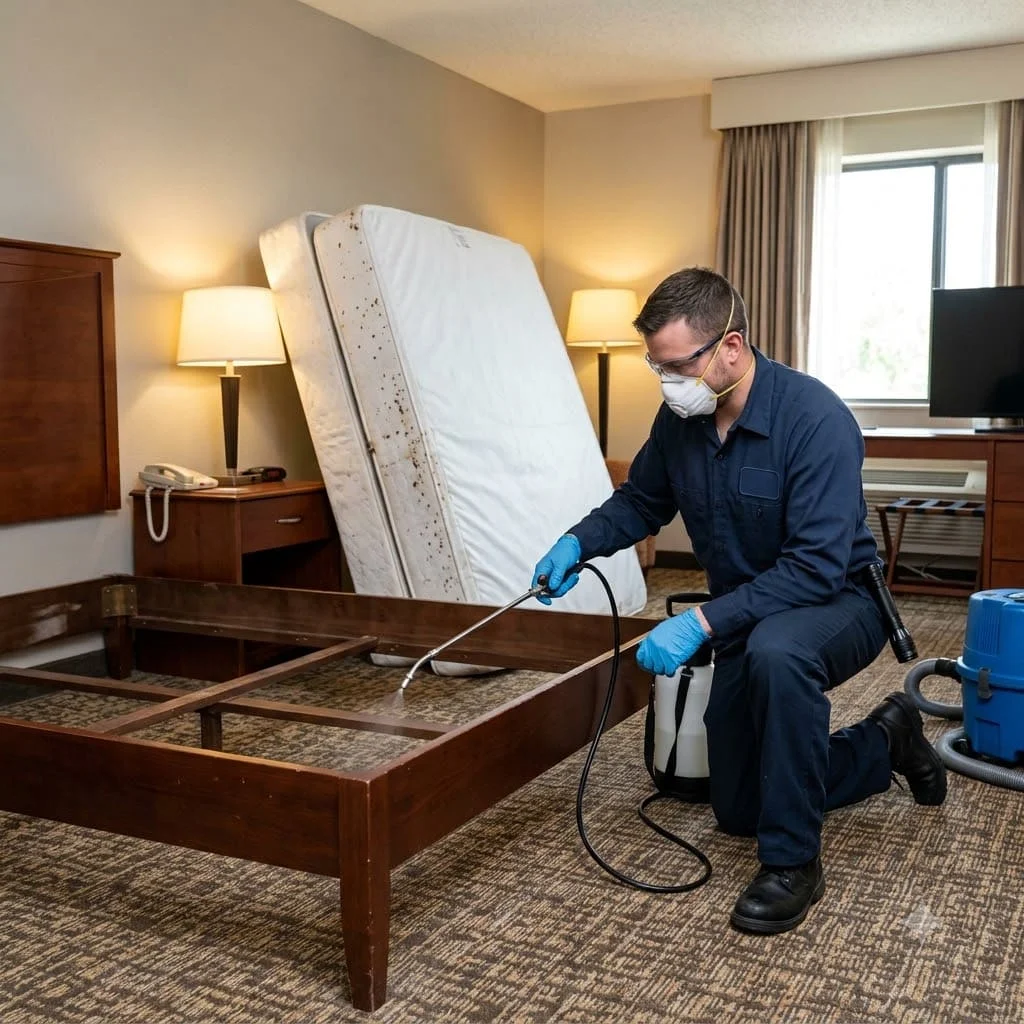
Senior living is the setting where the standard bed bug playbook fails, because almost every step of it assumes an occupant who can strip their own bed, bag their own clothing and leave the building for eight hours. Residents in assisted living and skilled nursing frequently can do none of those things, and a treatment plan that does not start from that fact will be abandoned halfway through or will simply not work.
Detection cannot rely on bites
The first thing that changes in a care setting is how infestations are found. Skin reaction to bed bug bites declines with age, and around a third of adults show no visible reaction at any age. Layer on fragile skin, anticoagulant use that changes how marks present, and cognitive impairment that affects reporting, and bites become close to useless as a detection signal.
It fails in both directions, which is the part facilities underestimate. Real infestations run for months with nobody reporting anything, and unrelated skin conditions get attributed to bed bugs and trigger expensive responses to a problem that does not exist. The bites guide covers why a mark on skin never confirms an infestation on its own.
Detection here has to rest on physical evidence and monitoring instead: interceptors under bed and chair legs, scheduled canine sweeps, and staff who know what fecal staining and shed skins look like on a mattress seam. Care staff make beds and handle laundry daily, which makes them the most capable detection layer in the building if anyone briefs them.
The constraints that change the method
Heat is the stronger treatment in general, because it kills every life stage including eggs in a single visit. In a care setting it collides with several hard constraints at once.
- Vacating for six to eight hours. Straightforward for a resident who can spend the day in a lounge. Genuinely difficult for someone with limited mobility, a fixed care schedule, or dementia for whom relocation is distressing rather than merely inconvenient.
- Oxygen equipment. Concentrators and cylinders have to be removed and accounted for before any thermal work. This is not negotiable and it is not a formality.
- Medication storage. Many medications degrade at the temperatures a heat treatment reaches, and refrigerated medications need a plan for where they go for the day.
- Specialist mattresses. Pressure-relieving overlays and alternating-air mattresses frequently cannot tolerate thermal treatment. Check the manufacturer instructions before the equipment arrives, not on the day.
- Mobility aids and sensory equipment. Walkers, hearing aids and glasses need to go with the resident, which sounds obvious and is the thing most often left behind in a hot room.
The practical result in most facilities is a mixed programme: heat in rooms that can be vacated or are already empty, and a chemical programme in occupied rooms, where residents need only be out for two to four hours or until surfaces are dry. The trade-off is the return visits — two to three per room, timed around the six-to-ten-day egg hatch — and the coordination that implies across a care rota. The heat treatment page covers where thermal work is and is not appropriate.
Preparation is the facility's job, not the resident's
In residential work, failed preparation is the leading cause of a treatment that has to be repeated. In a care setting, prep instructions handed to the occupant are not a plan at all — they are a plan to fail. The preparation has to be resourced by the facility and built with nursing input.
-
First
Build the room list with clinical staff
Oxygen, medications, specialist mattresses, mobility aids, care schedules and cognitive considerations, room by room. This determines which rooms can take heat and which cannot, before any quoting happens.
-
Second
Resource the prep with staff or the contractor
Someone has to strip beds, bag textiles and clear surfaces. Decide whether that is facility staff on paid time or a line item in the contractor quote, and agree it in writing.
-
Third
Plan where each resident spends the treatment window
A lounge, a day room, an activity session, or a temporarily vacant room without their belongings. Named plan per resident, not a general arrangement.
-
Fourth
Tell families before they hear it from the resident
A clear factual account of what was found, what is being done and when, sent proactively. Families who learn about it second-hand assume concealment, and that is a harder conversation than the original one.
-
Fifth
Treat the surrounding rooms in the same block
The reported room plus either side, above and below, on the same schedule. Rolling room-by-room treatment lets the population stay ahead of the work.
-
Finally
Install interceptors and re-inspect at two weeks
Monitoring is what replaces bite reports here. Documented per room, and kept on file after the matter appears closed.
Dignity is part of the specification
There is a version of this work that is technically correct and still bad care. A resident whose room is stripped by strangers, whose possessions are bagged in front of them, and who is told very little about why, experiences something quite different from a pest control appointment.
Ask for technicians who will explain what they are doing to the resident directly rather than only to staff, work at a pace that allows it, and handle possessions with the resident's knowledge. Ask for discretion in the building as well — unmarked vehicles, service entrances, no signage — because reputation in this sector travels through families and referral networks, and because residents deserve not to have their room identified to every visitor in the corridor. Any contractor who treats these as unusual requests does not do much work in the setting.
What it costs
A single resident room prices much like a small apartment: roughly $400 to $900 for chemical work and $700 to $1,500 for heat. The room count is rarely one, and facility-wide programmes are quoted per door well below the single-room rate.
Expect a well-built quote to carry a preparation and coordination allowance a residential job would not, because the prep genuinely cannot be delegated to the occupant. A quote that matches a residential per-room price exactly is usually one that has not understood the setting, and the cost of that shows up later as a treatment aborted on the day. Ask for inspection and treatment priced separately, and read the cost page for the underlying ranges.
Call us and we will get someone out who has worked in care settings before — it matters more than it sounds. Families with concerns about a relative’s room will find the senior living guide more directly useful than this page.