
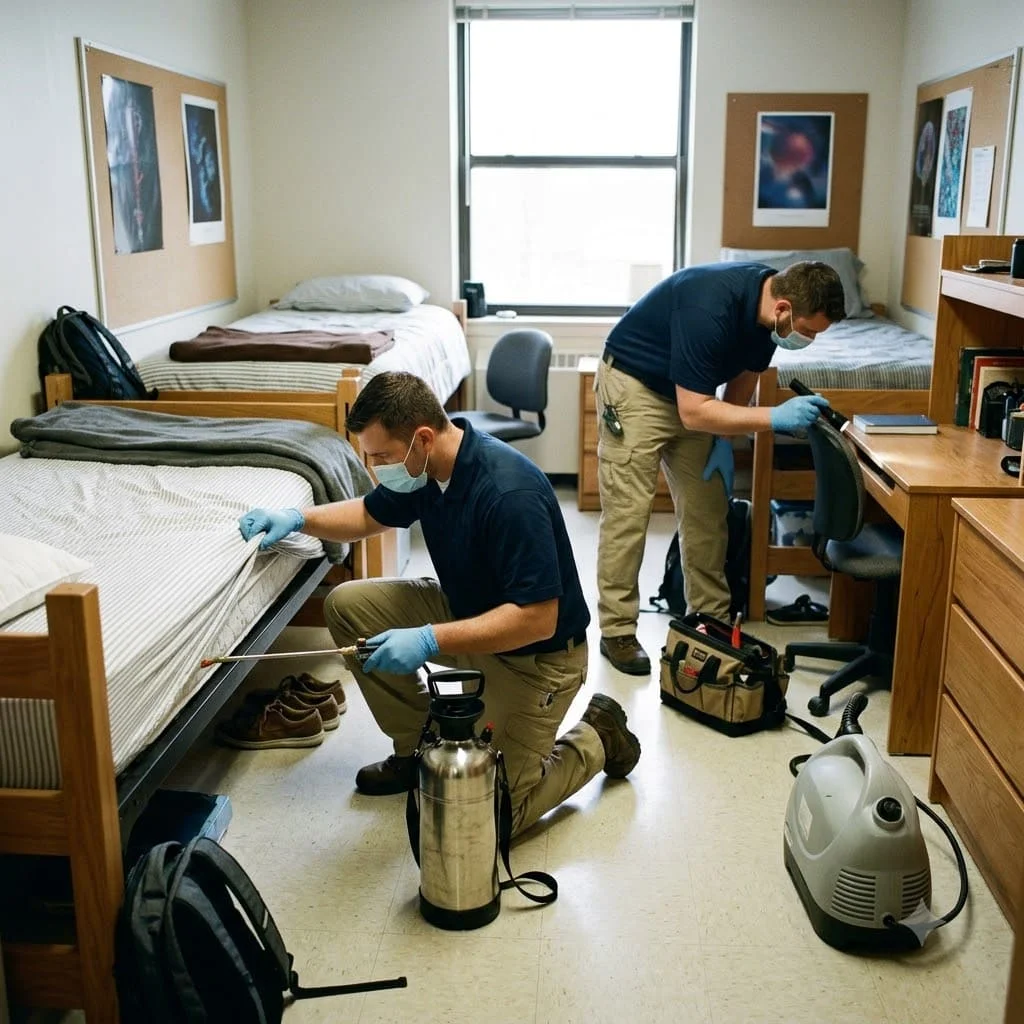
Student housing bed bug reports concentrate into a predictable annual window — late August through September — because move-in week delivers thousands of suitcases from thousands of different buildings into one structure in the space of a few days. The spike is not a mystery and it is not bad luck. It is a scheduling problem with a known date, which makes it one of the few bed bug risks that can genuinely be got ahead of rather than responded to.
Why the spike lands where it does
Nothing about bed bug biology changes in August. What changes is the rate of arrival. A residence hall that sat mostly empty through summer takes on several hundred residents inside a week, and each one brings luggage that was recently in a car, a family home, an airport, a hotel or a storage unit.
Second-hand furniture compounds it. Students furnish rooms and first apartments from Facebook Marketplace, Craigslist, campus free piles and thrift shops, and upholstered furniture bought sight-unseen is the single highest-risk item anyone can move into a building. A sofa collected on the Saturday of move-in weekend can seed a floor before term starts.
The reports themselves lag the arrivals by two to four weeks, which is why the calls come in late September rather than during move-in. A handful of insects introduced in August are not noticeable. The same population three weeks later, after a generation of feeding, is. By the time a resident reports bites, the infestation has usually had a month to establish and to move.
The Washington campus picture
The pattern repeats across every Washington campus with residential housing, though the shape of the risk differs with the building stock.
- Western Washington University, Bellingham. Large residential population in a mix of mid-century halls and newer apartment-style buildings, with a substantial off-campus rental market in the surrounding neighbourhoods that shares the same move-in week.
- Eastern Washington University, Cheney. A small city where the student population dominates the rental stock, so on-campus and off-campus infestations circulate through the same furniture and the same social networks.
- Central Washington University, Ellensburg. Similar dynamic to Cheney, with the added factor of summer conference and camp bookings that keep halls occupied by short-stay guests through July and August.
- The Evergreen State College and South Puget Sound Community College, Olympia and Lacey. Apartment-style and modular campus housing, plus a large commuter share living in Olympia rentals rather than on campus.
- The Seattle and Tacoma cluster. University of Washington, Seattle University, Pacific Lutheran and Puget Sound sit in the densest rental markets in the state, where a student rental is usually a unit in a multi-family building and everything on the apartments page applies.
- Gonzaga and Whitworth, Spokane. Older housing stock in the surrounding neighbourhoods, and a rental market with high turnover between academic years.
Summer conference use is the factor most often missed. Halls let out to camps, athletics programmes and visiting groups between June and August run at hotel-like turnover with none of the housekeeping routine a hotel has, and carryover from that period is frequently what a September report is actually finding.
What changes in an institutional building
Student housing is multi-family housing with three complications layered on top, and a company that treats it as an ordinary apartment job will miss all three.
The first is the reporting chain. A resident tells an RA, the RA tells residence life, residence life raises a work order, and facilities books a vendor. Every step adds days, and the infestation does not pause for the process. Buildings that shorten this chain — a direct reporting route that does not route through a peer — find infestations meaningfully earlier.
The second is the room-swap instinct. Moving an affected student to a spare room is the intuitive response and it is close to the worst available action, because it relocates the infestation into a clean room along with the belongings. The correct sequence is to treat, not to move; where a move is genuinely unavoidable, the belongings are handled separately from the resident.
The third is scope. Dorm rooms share walls, wiring chases and often a common lounge and laundry, so the same rule that governs apartment work applies: the reported room plus the rooms either side, above and below, as a working minimum. Treating a single room in a corridor of forty is how a building ends up paying twice in one term.
The pre-move-in sweep
The strongest thing a housing operation can do costs less than the treatment it avoids: sweep the building in early August, while it is empty.
-
First
Sweep the empty building in early August
A certified canine team clears a large hall in a morning. Empty rooms need no resident notice, no prep and no scheduling around occupancy, which is why this is the cheapest inspection of the year.
-
Second
Treat carryover before anyone arrives
Anything the sweep finds is treated in a vacant building with no resident disruption and no prep failures. This is the one window in the calendar where heat is uncomplicated.
-
Third
Put interceptors under every bed
Interceptors under bed legs give an objective read through the term without relying on residents to report bites. They cost a few dollars a bed and they are the difference between finding an infestation in week three and week nine.
-
Fourth
Brief RAs on what evidence looks like
A twenty-minute briefing on staining, shed skins and where to look turns the people who walk through rooms weekly into a detection layer. Photographs beat descriptions.
-
Fifth
Publish a reporting route that is not the RA
A form or address that reaches facilities directly removes the social cost of reporting, which is the main reason students stay quiet. Anonymous routes surface reports earlier than named ones.
-
Finally
Re-sweep at winter break
The second empty window in the academic year. A mid-year sweep catches anything introduced in the autumn term while the building is unoccupied and prep is free.
Heat and chemical in dorm buildings
Dorm rooms are well suited to heat treatment in principle. They are small, frequently hard-floored, sparsely furnished, and easy to vacate for the six to eight hours a thermal treatment needs — none of which is true of a family apartment.
Two building constraints decide whether it is practical. Electrical capacity in older residence halls often cannot support thermal equipment without a generator, which changes both the quote and the scheduling. And sprinkler heads activate at temperatures a heat treatment approaches, so the plan has to account for them explicitly rather than discovering the problem on the day.
Chemical programmes suit occupied buildings mid-term, because rooms can be treated on a rolling schedule without emptying a floor. The trade-off is the return visits — two to three per room, timed around the six-to-ten-day egg hatch — and the coordination that implies across an academic calendar with exams and breaks in it. The chemical treatment guide covers why that schedule is what it is.
Off-campus rentals and student tenants
Most Washington students do not live in university housing, and the rules change the moment they move off campus. In most rental housing the landlord carries a duty under RCW 59.18.060 to control infestation.
The exception matters more to students than to almost any other group: in single-family residences that duty applies at the commencement of the tenancy rather than continuously through it. A shared house rented by five students near campus may well be a single-family residence. A unit in a purpose-built student block is not. Establishing which one you are in is the first step in any dispute about who pays.
Whatever the housing type, report in writing rather than by text or in person, describe what was actually found rather than what it is assumed to mean, attach dated photographs, and keep every reply. A verbal report that is later disputed is worth very little.
What student housing treatment costs
A single dorm room prices much like a small apartment: roughly $400 to $900 for chemical work and $700 to $1,500 for heat. Those are per-room figures, and chemical is quoted per visit rather than per programme, so a room needing three visits is not the number on the first line of the quote.
Institutional pricing works on a different basis. Whole-building canine sweeps are quoted per door and come in far below single-property inspection rates, and a standing contract with a pre-move-in sweep and a winter re-sweep prices lower again than two sweeps bought separately. Ask for inspection and treatment priced as separate line items, so a sweep can be authorised without committing to a treatment scope before anyone knows what the sweep finds. The cost page sets out the underlying ranges, and the student housing guide covers what an individual student can do about a room they are already in.
Call us and we will get an exterminator out to the building. Tell us how many rooms are affected and whether it is term time — both change what a company can realistically schedule.