Washington Bed Bug Solutions
Services & areas

Colonies peak in August and September

Wasp & Hornet Nest Removal in Washington

A nest removed in May is the size of a golf ball. The same nest in late August holds thousands of workers and defends itself as a group.

Call us at (206) 555-0142

Speak to someone now — we will get an exterminator out to you.

  • Ground and wall-void nests
  • Never plug the entrance
  • Ask for the WSDA licence number

Licence you can check

Applying pesticides for hire in Washington requires a WSDA applicator licence. Ask for the number on the call — it is public and you can verify it yourself.

Statewide reach

Coverage from Whatcom to Clark and east to Spokane, routed by ZIP rather than by city name.

No cost to you

Companies pay us a referral fee. You are never billed by us and never obliged to book.

Wasp work in Washington is almost entirely a late-summer problem, and the reason is arithmetic rather than temperament.

Every colony in the state started in spring as a single overwintered queen. By mid-August it has been building for four months and is at maximum size. At the same time the brood-rearing phase finishes, so workers stop hunting protein for larvae and start seeking sugar — which is exactly when they begin arriving at bins, fallen fruit and outdoor tables in numbers.

What you are looking at

Type Nest Behaviour
Paper wasps Small open comb with visible cells, hanging from a short stalk. Under eaves, in gutters, inside pipe ends and BBQ covers. Comparatively unaggressive and will usually tolerate people passing. The European paper wasp is now widespread across the state and is the one most often found in odd cavities.
Yellowjackets, ground-nesting Enclosed paper nest inside an old rodent burrow or void in the ground. Entrance is a single hole with steady traffic. Highly defensive. Most stings in Washington come from someone running a mower or strimmer over an entrance they never saw.
Yellowjackets, cavity-nesting Inside wall voids, attics, soffits and floor cavities, entering through a gap in siding, a vent or a utility penetration. The job that most needs a professional, and the one where the common DIY response causes the most damage. See the warning below.
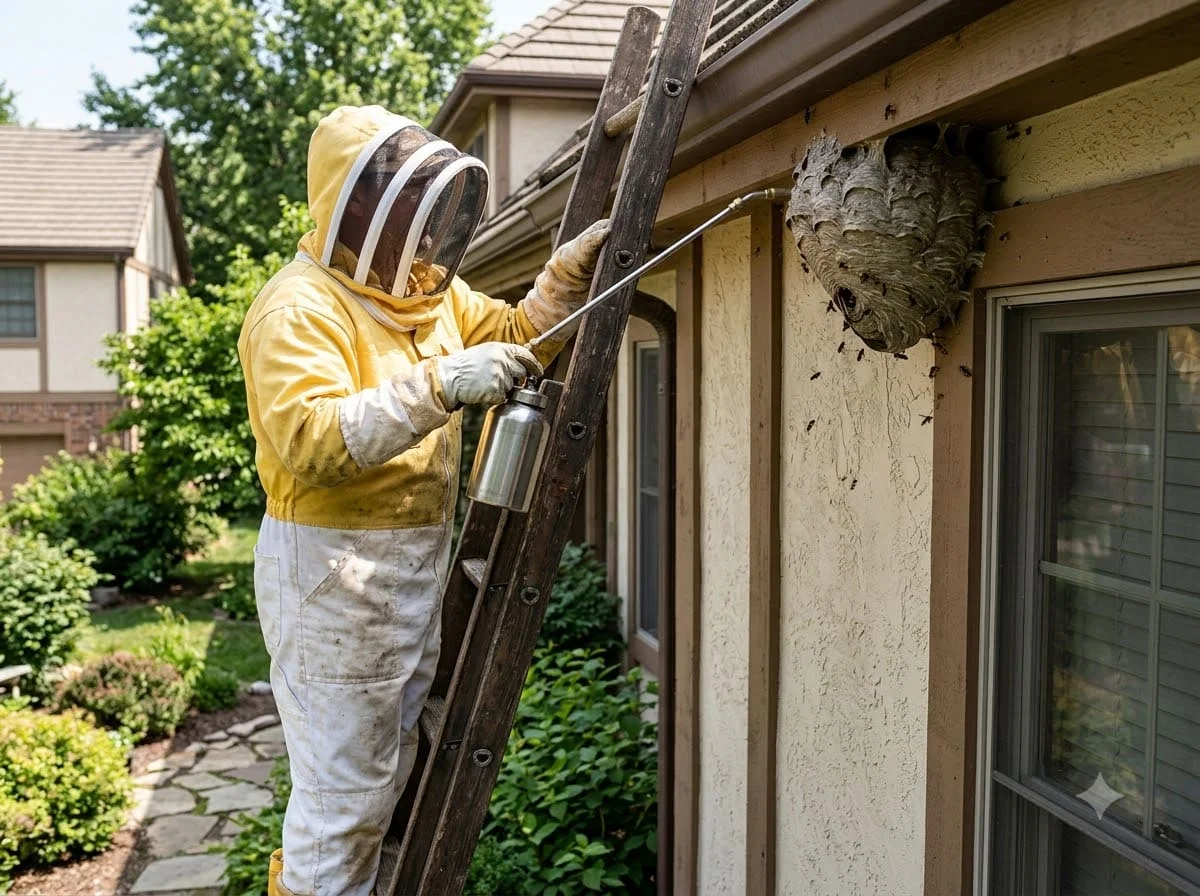
Bald-faced hornet The large grey football-shaped aerial nest in a tree, shrub or under an eave. Can reach the size of a basketball. Despite the name it is a yellowjacket, not a true hornet. Very defensive of the nest and quick to respond in numbers.

The northern giant hornet question

Washington spent five years as the only US state with a confirmed northern giant hornet population, after the first detection in Whatcom County in 2019. That is over.

On 18 December 2024, WSDA and USDA announced that the species had been eradicated from Washington and from the United States, following three consecutive survey years with no detections — the standard threshold for declaring an eradication successful.

Reporting a suspected sighting is still worthwhile, because public reporting is how a reintroduction would be caught early, and WSDA maintains a reporting route for exactly that. But if you are looking at a very large wasp in Washington in 2026, the realistic candidates are a bald-faced hornet, a European hornet, a western cicada killer, or one of several large native look-alikes. WSDA publishes a side-by-side identification guide.

When it is a homeowner job and when it is not

A small, fully visible paper wasp nest, early in the season, on a wall you can reach standing on the ground, treated at dusk when the colony is in and inactive, is a reasonable DIY job.

Three situations are not, and it is worth being blunt about why.

Any nest in a wall void or attic. You cannot see the size of it, you cannot reach it directly, and the failure mode is the one described above.

Any ground nest. The colony is larger than the entrance suggests, the response to disturbance is immediate and collective, and you have nowhere to retreat to that they cannot follow.

Anything needing a ladder. Most serious wasp injuries in Washington are fall injuries rather than sting injuries. Being stung on a ladder is how people come off ladders.

Add to that anyone in the household with a known sting allergy, in which case none of this is a DIY question at all.

What reduces the problem next year

Queens found new nests in spring, so the useful work is done in April and May rather than August. Check eaves, soffits, gutter runs, sheds, open pipe ends, unused BBQs and roof voids for early nests the size of a golf ball, when a single queen is present and removal is trivial.

Then close the cavities. Screen or seal the gaps in siding, vents and utility penetrations that gave last year’s colony access, once you are certain it is inactive. Keep bins lidded and rinse recycling from July, because sugar residue at the kerb is what concentrates foraging workers around a doorway in August.

What nest removal costs in Washington

An accessible aerial nest runs $150 to $400 in 2026. Ground nests, wall voids and high or awkward access sit at the top of that range or above it, because the work takes longer and needs more equipment.

Ask whether a return visit is included where a cavity nest needs confirming clear, since that is the one most likely to need a second look. Removing an old nest after the season is cosmetic — in this climate nests are not reused. The statewide pest control page carries the full cost table across all eight services.

Our promise

No surprises, and nothing charged to you

Bed bug work is priced on what a technician finds in the room, so any figure quoted before an inspection is a guess. What we can promise is the part we control: the call is free, the referral is free, you are under no obligation to book, and if nobody covers your ZIP we say so on the call instead of taking your details anyway.

Call us at (206) 555-0142

Free call, free referral, no obligation.

Frequently asked questions

Why are wasps suddenly everywhere in August?

Two things happen at the same time. The colony reaches its maximum size in late summer after building all year from a single overwintered queen, so there are simply far more of them than in June. And the colony switches diet — with the brood-rearing largely finished, workers stop hunting protein for larvae and start seeking carbohydrates, which is why they appear at every barbecue, bin and fallen-fruit tree from roughly mid-August. The aggression people notice is the same insects being hungrier and more numerous, not a change in temperament.

What is the difference between a wasp, a yellowjacket and a hornet?

In Washington the practical distinction is between aerial paper wasps and yellowjackets. Paper wasps, including the widespread European paper wasp, build small open-comb nests with visible cells under eaves, in gutters and inside pipe ends, and are comparatively unaggressive. Yellowjackets build enclosed nests with a paper envelope, either underground in old rodent burrows or inside wall voids and attics, and defend them vigorously. The bald-faced hornet, despite its name, is a yellowjacket — it builds the large grey football-shaped aerial nests in trees and on eaves.

Are the northern giant hornets still in Washington?

No. WSDA and USDA announced on 18 December 2024 that the northern giant hornet, first detected in Whatcom County in 2019, had been eradicated from Washington and from the United States, following three consecutive survey years with no detections. It is still worth reporting anything you believe matches, because ongoing public reporting is part of how a reintroduction would be caught early. What you are far more likely to be looking at is a bald-faced hornet, a European hornet, or one of several large native look-alikes.

Can I remove a wasp nest myself?

A small, accessible, early-season paper wasp nest is within reach of a careful homeowner working at dusk with the right product. Three situations are not: any nest in a wall void or attic, any ground nest, and any nest large enough that you cannot see all of it. Yellowjacket colonies at peak size can hold thousands of workers, they recruit defensively en masse, and unlike honeybees they sting repeatedly. Ladder work adds a fall risk on top of the sting risk, and most serious wasp injuries in this state involve a ladder.

Why should I never plug the entrance to a nest in a wall?

Because a colony denied its usual exit does not give up — it chews through whatever is softest to find another way out, and from inside a wall void the softest material is very often the interior drywall. Sealing the outside entrance of an active wall-void nest is the single most reliable way to move several thousand yellowjackets from a cavity into a bedroom. The correct sequence is to treat the colony first, confirm activity has stopped, and only then seal the opening so nothing else uses it next year.

What does wasp nest removal cost in Washington?

An accessible aerial nest typically runs $150 to $400 in 2026. Ground nests, wall voids and anything above single-storey ladder height sit at the upper end or above it, because the work takes longer and needs more equipment. Some companies price a second visit into the job where a wall-void nest needs confirming clear; ask whether that is included. Removing an old, inactive nest is largely cosmetic — a temperate-climate nest is not reused the following year.

Do wasp nests get reused the next year?

No. In the Washington climate the entire colony dies with the first hard frosts, apart from newly mated queens who overwinter alone in sheltered spots such as loose bark, log piles and roof voids. Those queens found new nests in spring and do not return to the old one. So an abandoned nest is not itself a risk. What matters is that a site attractive once is usually attractive again, which is why sealing the cavity after treatment is worth doing even though the nest itself is finished.

Sources

Figures on this page are ranges drawn from the sources above and from published 2026 regional pricing. Treatment is quoted on what a technician finds on site, so treat every number here as a planning range rather than a price.

Get a nest dealt with safely

Ground nests and wall voids are the two worth paying for. Call and we will get a local pest control company out to you.

No cost, no obligation. Lines are open now.