
Washington Bed Bug Solutions
Services & areas

The western Washington structural pest

Moisture Ant & Carpenter Ant Control in Washington

Neither species eats wood. Both move into wood that damp has already ruined — which makes finding them a building diagnosis, not just a pest one.

Call us at (206) 555-0142

Speak to someone now — we will get an exterminator out to you.

  • Nest located, not just the trail
  • Moisture source identified
  • Ask for the WSDA licence number

Licence you can check

Applying pesticides for hire in Washington requires a WSDA applicator licence. Ask for the number on the call — it is public and you can verify it yourself.

Statewide reach

Coverage from Whatcom to Clark and east to Spokane, routed by ZIP rather than by city name.

No cost to you

Companies pay us a referral fee. You are never billed by us and never obliged to book.

Carpenter ants and moisture ants are the genuine structural insect problem in western Washington, and the most important thing about both is that neither one caused the condition it is living in.

Carpenter ants excavate galleries in wood that moisture has softened. Moisture ants go further and colonise wood that is already in advanced decay. Neither species eats wood or takes any nutrition from it. What they do is occupy a defect that already existed.

Which means the finding is diagnostic. An operator who treats the ants and says nothing about where the water is coming from has solved the visible half of a two-part problem, and left the half that determines whether you are calling again next spring.

Carpenter ants, moisture ants, termites

Three wood-associated insects turn up in Washington structures and they are routinely confused with each other, including by people selling treatment. The debris each leaves behind is the fastest way to separate them.

What you found What it means What the wood is like
Clean fibrous shavings with insect parts Carpenter ant frass, pushed out of a slit-shaped gallery opening. Often piled below trim, a window header or a joist. Sound but damp-softened. Galleries are smooth and sanded-looking inside, following the grain.
Soil-like material packed into decayed wood Moisture ants. They build carton nests using excavated wood and soil, in timber that is already rotting. Actively decaying, often crumbling under a screwdriver. Usually wet to the touch.
Mud tubes on foundation or wood surfaces Western subterranean termites. Not ants at all — they travel in covered tubes to keep contact with soil moisture. Galleries packed with soil and faecal material, running with and across the grain.

If it is the third row, the termite inspection page covers what a complete wood-destroying organism inspection involves and what the licence requirements are in this state.

Where they nest in Washington housing

The locations repeat, because the water sources repeat. Everything on this list is somewhere that a Washington building routinely gets wet and routinely stays wet.

The sill plate and rim joist above a damp crawlspace, particularly where the vapour barrier is incomplete. Framing around a leaking shower pan, bath or toilet. Window and door headers where flashing has failed and the trim has been repainted over the evidence. The wall cavity behind an outside tap. Roof sheathing beneath a failed valley or a chimney flashing. Porch posts and deck ledger boards. And the base of a door frame or siding run in direct ground contact.

Outdoors, the parent colony is frequently within a hundred yards — a stump, a woodpile stacked against the house, a landscape timber, or a tree with heart rot. Satellite nests inside the building are connected to it by foraging trails, which is why treating only what is indoors can leave the source untouched.

How the job should run

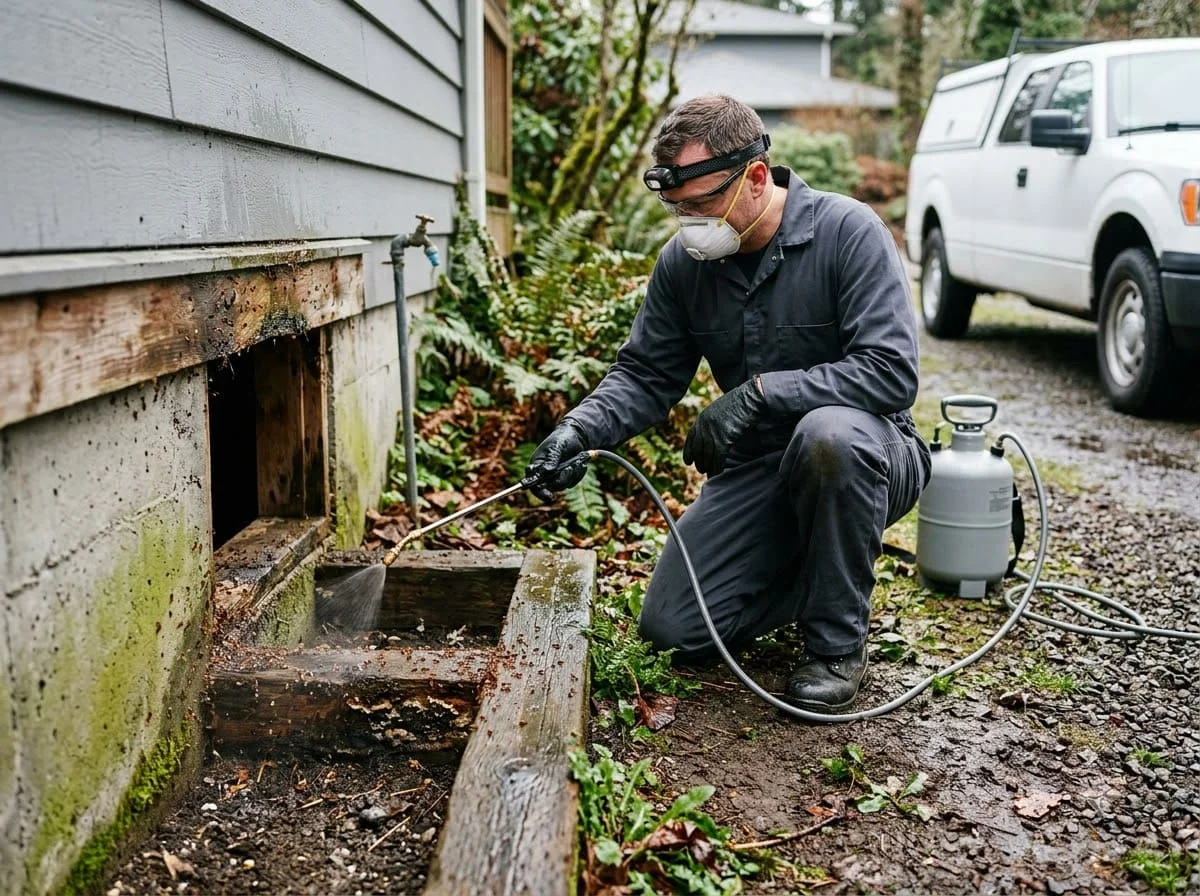
Locating the nest is the work. Everything else is straightforward once it is found. Technicians listen for the rustling a large colony makes in a quiet wall, probe suspect timber with a moisture meter and a screwdriver, follow foraging trails at dusk when carpenter ants are most active, and look for the frass piles that mark a gallery opening. A quote produced without any of that is a quote for spraying a perimeter.

Non-repellent materials, not contact sprays. The point is that foragers pick the material up without detecting it and carry it into the nest. Repellent products do the opposite — they push a colony deeper into the structure or cause it to bud into satellite nests, which is how a single-nest problem becomes a three-nest problem.

Direct treatment of the gallery where it is accessible. Dust applied into a located void treats the nest itself rather than the traffic around it, and it is the difference between one visit and four.

A written note of the moisture source. This is the deliverable that matters most and the one most often missing. Ask for it explicitly: where the water is entering, which timber is affected, and what the moisture readings were.

The repair is the actual fix

Treatment clears the colony. It does not dry the wood, and while the wood stays wet the site remains attractive to the next colony and to wood-rotting fungus, which is the organism doing most of the structural damage in Washington in the first place.

The repair list is unglamorous and largely about water management: clearing and re-pitching gutters and downspouts so they discharge away from the foundation, re-flashing the failure, laying a complete crawlspace vapour barrier and confirming the vents are clear, taking siding and trim out of ground contact, moving the woodpile off the wall, and cutting back vegetation that keeps a wall permanently damp.

Structural timber that has lost integrity needs replacing rather than treating. That is a carpentry quote, not a pest control one, and the two should be priced separately so you can see what you are buying.

What it costs in Washington

Treatment runs $250 to $600 in 2026, driven mostly by whether the nest gets located. Located and directly treated is often one visit. Working from trails alone means repeat visits and a longer non-repellent programme.

The wood repair and the water fix sit outside that entirely, from a few hundred dollars for a section of trim to five figures where a rim joist or sill plate has failed. The statewide pest control page carries the full cost table across all eight services, and ant control covers the nuisance species that do not damage buildings at all.

Our promise

No surprises, and nothing charged to you

Bed bug work is priced on what a technician finds in the room, so any figure quoted before an inspection is a guess. What we can promise is the part we control: the call is free, the referral is free, you are under no obligation to book, and if nobody covers your ZIP we say so on the call instead of taking your details anyway.

Call us at (206) 555-0142

Free call, free referral, no obligation.

Frequently asked questions

Do carpenter ants eat wood?

No, and this is the most consequential misunderstanding about them. Carpenter ants excavate galleries to nest in and push the debris out; they do not consume the wood and take no nutrition from it. That is why the material below a gallery opening is clean, fibrous shavings mixed with insect body parts rather than the compacted pellets or mud that termites produce. It also explains why a carpenter ant infestation is a slower structural problem than a termite one, and why the wood they chose was almost always softened by moisture first.

What is the difference between carpenter ants and moisture ants?

Carpenter ants are large, usually black or black and red, and will excavate wood that is sound but damp-softened — they can work into structurally significant timber. Moisture ants are smaller, typically yellowish to light brown, and colonise wood that is already in advanced decay. Neither causes the decay. The practical difference is what the finding tells you: carpenter ants mean there is moisture somewhere, and moisture ants mean there is active rot, which is the more urgent building problem of the two.

I saw winged ants indoors in spring. What does that mean?

A swarm of winged reproductives inside a building in late winter or spring almost always means the colony is inside the structure rather than outside it. Carpenter ants swarm from about February through June in Washington, on the first warm damp days. Winged ants can be told from winged termites by three features: ants have elbowed antennae, a pinched waist, and forewings noticeably longer than the hindwings, while termites have straight beaded antennae, a broad waist, and four wings of equal length. Keep a specimen — the identification changes the whole job.

Where do carpenter ants nest in a Washington house?

Follow the water. The recurring locations are the sill plate and rim joist above a damp crawlspace, framing around a leaking bathroom or shower pan, window and door headers where flashing has failed, the wall behind a hose bib, roof sheathing under a failed flashing or valley, porch and deck ledger boards, and the base of a door frame in ground contact. Outdoors, the parent colony is often in a stump, a woodpile or a tree with heart rot within a hundred yards, with satellite nests inside the building.

Can I treat carpenter ants myself?

Surface sprays and retail granules are unlikely to solve it, because the colony is inside a void you cannot see and the sprays are repellent — the usual outcome is the ants relocating deeper into the structure or budding into satellite nests, which makes the eventual professional job harder and more expensive. Locating the nest is the skill being bought here. If you want to do something useful yourself, find and stop the water: fix the flashing, clear the gutter, replace the failed caulk, lay the vapour barrier.

What does carpenter and moisture ant treatment cost in Washington?

Treatment typically runs $250 to $600 in 2026, with the range driven almost entirely by whether the nest is located or only the trail is. A job where the technician finds the gallery and treats it directly can be one visit; a job where they are working from trails alone needs repeat visits and non-repellent perimeter applications to get material carried back. Repairing the wood and stopping the water is separate and is carpentry — anywhere from a few hundred dollars for a section of trim to five figures if a rim joist has gone.

Will the ants come back after treatment?

If the moisture source is still there, yes, and that is the honest answer. These species occupy damp and decayed wood; while the habitat exists, the site remains available to the next colony. A treatment that clears the current infestation buys you the window to fix the leak. A pest control company that treats and never mentions the water has completed half of a two-part job, and the half they left is the one that determines whether you are calling again next spring.

Sources

Figures on this page are ranges drawn from the sources above and from published 2026 regional pricing. Treatment is quoted on what a technician finds on site, so treat every number here as a planning range rather than a price.

Get the nest located, not just the trail

Carpenter and moisture ant work is priced on finding the colony and the water behind it. Call and we will get a local exterminator out to you.

No cost, no obligation. Lines are open now.