Almost everything written about termites online is about the wrong species for this state.
National pest content describes drywood termites and Formosan termites — neither of which is established in Washington. What is here is the Pacific dampwood termite and the western subterranean termite, and they behave differently enough that the identification changes the diagnosis, the treatment and the urgency.
Washington also regulates this work more tightly than most pest services. A complete wood-destroying organism inspection requires its own WSDA licence, the report carries an inspection control number, and its contents follow a form prescribed in regulation.
The two species that are actually here
| Species | Where and when | What it means for the building |
|---|---|---|
| Pacific dampwood termite | West of the Cascades mainly. Decaying stumps, logs, and structural timber that has been wet for a long time. Swarms August to October, in the evening, often around lights. | The largest termite in the United States. Requires high wood moisture and cannot establish in dry timber, so its presence is first of all a moisture finding. |
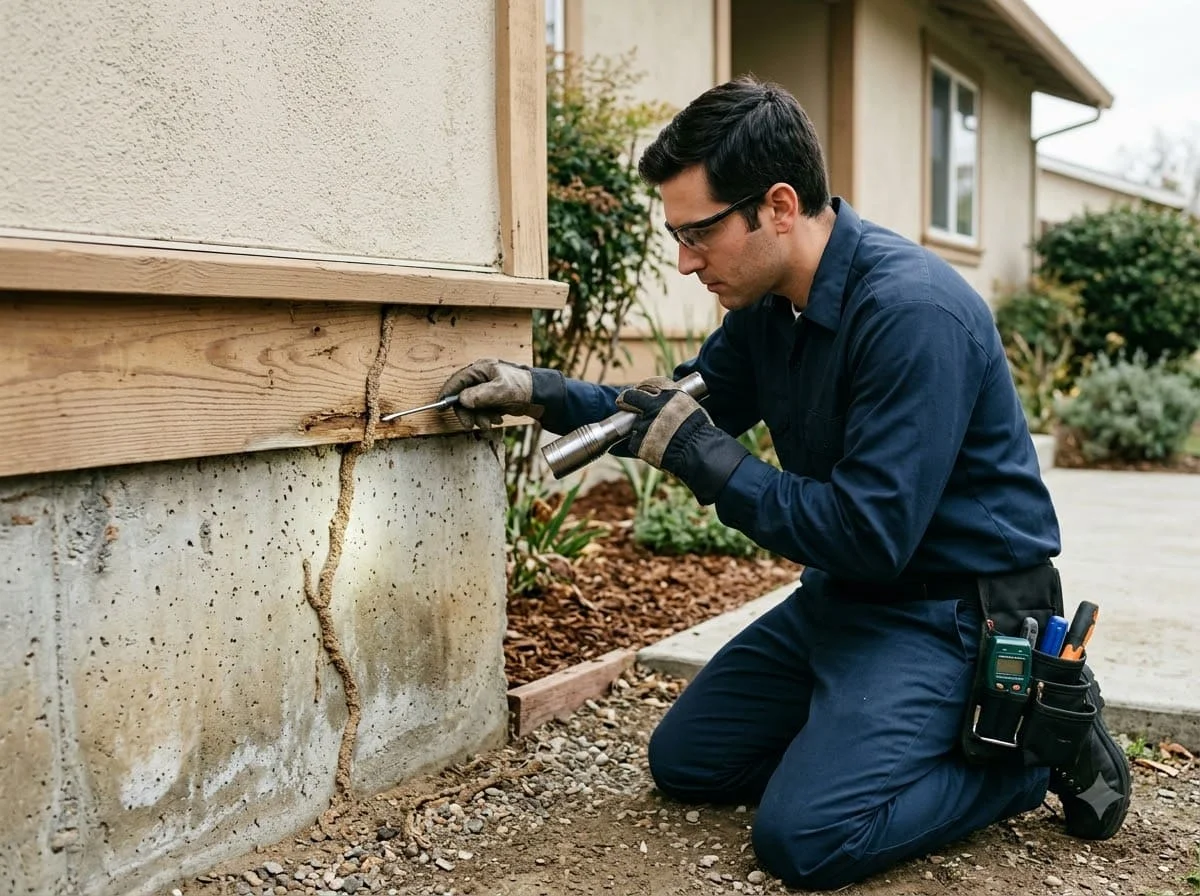
| Western subterranean termite | Present on both sides of the state, tied to soil. Swarms in spring, roughly February to April, on warm damp days and often in the middle of the day after rain. | The species capable of serious damage to sound structural wood. Maintains contact with soil moisture through mud tubes, which are the diagnostic sign. |
| Drywood and Formosan termites | Not established in Washington. | Occasional specimens arrive in imported furniture. Any local content describing drywood pellet piles or Formosan treatment protocols is not written for this state. |
What a complete WDO inspection is, in Washington terms
The phrase people search for is “termite inspection”. The product they usually need is a complete wood-destroying organism inspection, and in this state that is a regulated thing rather than a marketing term.
Three points are worth knowing before you book one.
It requires a specific licence. Performing a complete WDO inspection in Washington requires a WSDA structural pest inspector licence, which is separate from and additional to the applicator licence needed to apply pesticides. Ask which licence the person attending holds.
The report carries an inspection control number. A complete WDO report is issued with an ICN and its content follows the criteria set out in WAC 16-228-2005 onward. A one-page letter with no control number is not a complete WDO report, whatever it is called.
It covers far more than termites. The scope includes termites, carpenter ants, moisture ants, wood-boring beetles and wood-rotting fungus, plus conducive conditions — earth-to-wood contact, inadequate crawlspace ventilation, drainage failures, standing water, and excessive moisture readings. In Washington, rot and carpenter ants are the findings far more often than termites are.
When you need one
There is no blanket state requirement to inspect before a sale, but the transaction usually creates one. Lenders — particularly on VA loans and some FHA loans — commonly require a complete WDO inspection, and buyers often ask for one regardless of the lender.
Outside a transaction, the triggers are straightforward: a swarm indoors in spring or autumn, mud tubes anywhere on the foundation or piers, timber that sounds hollow or gives under a probe, persistent damp in a crawlspace, and any property where a previous report noted conducive conditions that were never corrected.
What the report should tell you
A useful report distinguishes between three separate things, and a weak one blurs them.
Evidence of infestation — live organisms or signs of current activity, and precisely where. Evidence of damage — what the organism has already done to the structure, which may be historic and inactive. And conducive conditions — the drainage, ventilation, ground contact and moisture problems that will bring the organism back whether or not it is present today.
It should also state clearly what was not inspected and why: crawlspace areas with insufficient clearance, sections behind stored items, finished basements, and attic areas with no access. Those exclusions are where later disputes come from, so read them before you rely on the report.
Treatment, and the part that is not chemical
Subterranean termite treatment is a soil job: trenching and treating the soil around the foundation with a non-repellent termiticide, sometimes with drilling through slabs, porches and patios where the soil cannot be reached from above. Bait station systems are an alternative approach on some properties. Either way, the treatment addresses the route rather than the colony directly.
Dampwood termite work is different, because the species cannot persist in dry wood. Removing the water and replacing the affected timber is the actual fix, and a chemical treatment without that is temporary by construction.
In both cases the durable work is water management: gutters and downspouts discharging clear of the foundation, grade sloping away from the building, a complete crawlspace vapour barrier with clear vents, siding and trim out of ground contact, and no woodpile or landscape timber against the wall. The same list appears on the moisture ant page, because it is the same underlying problem.
What it costs in Washington
A complete WDO inspection runs $150 to $400 in 2026, with access to the crawlspace and attic the main driver. Subterranean termite treatment runs roughly $1,200 to $3,500 depending on linear feet of foundation, whether slab drilling is needed, and warranty length.
Dampwood work is usually cheaper chemically and more expensive structurally, since the fix is carpentry and drainage. Ask for the inspection and any treatment to be priced separately, so you can commit to the report without committing to a scope before you know what the report says. The statewide pest control page carries the full cost table across all eight services.