
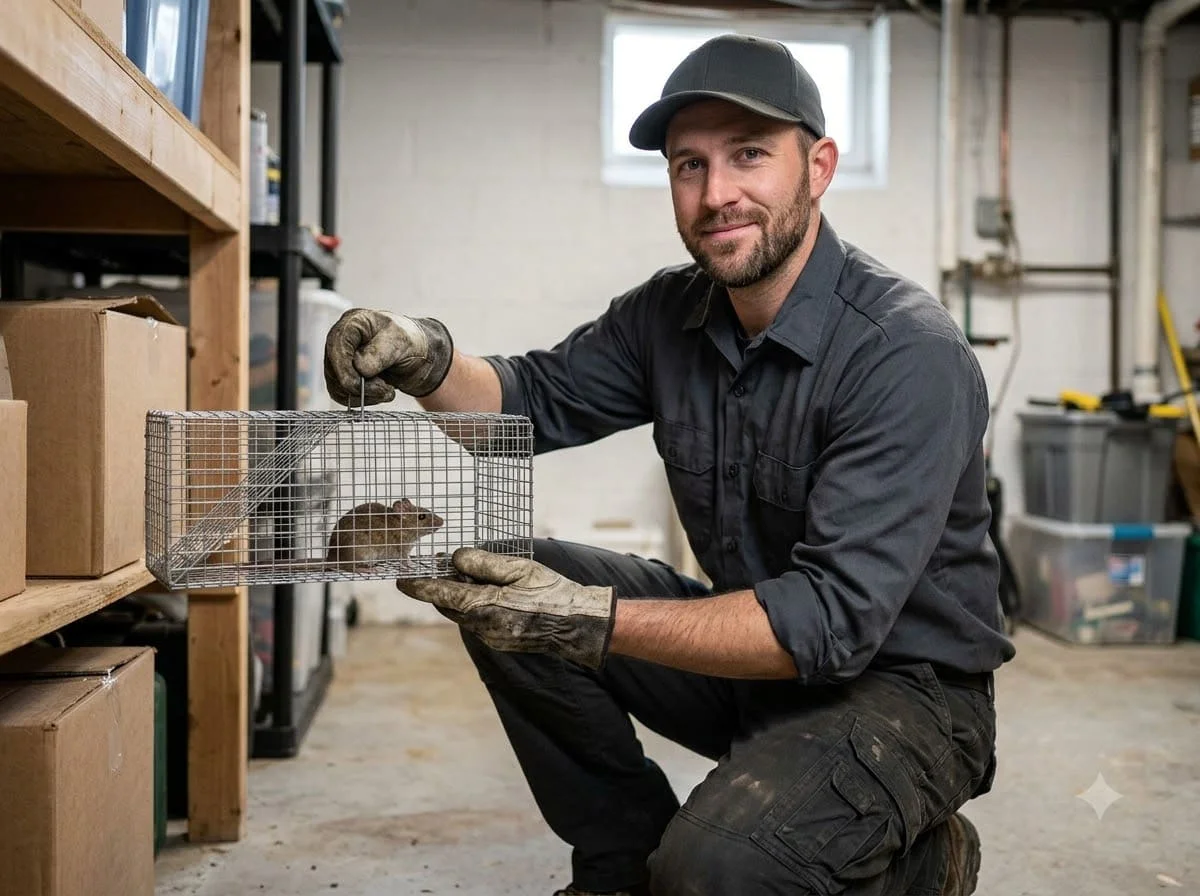
Rodent control in Washington is two jobs that get sold as one, and the cheaper half is the one that does not last.
Trapping removes the animals currently inside the building. Exclusion — finding and sealing the openings they used — is what determines whether you are doing this again next October. A quote that covers only the first half is a recurring service contract with a pest control label on it.
Which rodent you actually have
Three species account for nearly every residential callout in this state, and they behave differently enough that the identification changes the whole approach.
| Species | Where it lives | The tell |
|---|---|---|
| Roof rat | Attics, soffits, upper wall voids. Dominant west of the Cascades and throughout the Puget Sound corridor. | Noise above you, at night. Slender body, tail longer than the body. Arrives along utility lines, fence tops and branches touching the roof. |
| Norway rat | Crawlspaces, sheds, compost, burrows against foundations, sewer connections. | Noise below you. Heavier and blunter, tail shorter than the body. Burrow entrances the diameter of a golf ball near a wall or slab. |
| House mouse and deer mouse | Everywhere, but deer mice concentrate in rural and eastern Washington properties, outbuildings, garages and cabins. | Rice-grain droppings along wall bases and inside cupboards. Deer mice have a white belly and white feet with a distinctly bicoloured tail — that one matters, see below. |
Getting this right is not academic. A roof rat problem solved with ground-level traps in the crawlspace catches nothing, and three weeks of that is three weeks of gnawing on wiring in the attic.
Why exclusion is the part that matters
A house mouse passes through a quarter-inch gap. A young rat needs about half an inch. Both will gnaw a smaller opening into a usable one, and both are far better than you are at finding the openings.
Washington building stock offers a specific and repetitive set of them. Crawlspace vent screens that have rusted or been pushed in. The annular gap around plumbing, gas and cable penetrations. Garage door bottom seals that no longer meet the slab. Dryer and bathroom vent flaps that have stopped closing. The joint where a deck ledger board meets siding. Gable vents with damaged mesh. And, on older houses, the gap between the foundation top plate and the sill where the two never quite met.
Sealing is done with materials rodents cannot chew through — hardware cloth, sheet metal, mortar — not with expanding foam, which they remove in an evening. Expect the exclusion quote to read more like a carpentry estimate than a pest control one, because that is what it is.
Order matters. Trap first, confirm the building is clear, then seal. A building sealed while animals are still inside gives you a dead rodent in a wall void and no way to reach it.
The outdoor half nobody quotes for
Three things around a Washington property account for most sustained rodent pressure, and none of them are on a pest control invoice.
Branches and vegetation touching the roof or walls are a bridge; roof rats use them the way you would use a staircase, and cutting back to a three-foot clearance removes the route. Bird feeders, fallen fruit and open compost are a food supply that will sustain a population through the wet season indefinitely. And firewood, building materials or stored items stacked directly against the house give ground-level rodents cover right at the point where they can test the foundation for gaps.
A technician who mentions all three is telling you something useful. One who sets traps and says nothing has left the reason for the problem in place.
What rodent control costs here
Trapping programmes typically run $250 to $600 across two to four visits, driven by trap count and by how bad attic or crawlspace access is. Exclusion is quoted separately and ranges from around $300 for a handful of gaps and a vent screen to several thousand for a full crawlspace re-screen with subfloor repair.
Attic decontamination — removing contaminated insulation, sanitising and re-insulating after a long infestation — is a third job again, usually $1,500 to $6,000, and is the one most often skipped and most often needed. Quarterly maintenance plans run $100 to $175 a visit and make sense on properties with unavoidable pressure, such as a rural lot or a building next to a food business.
Compare this with bed bug treatment costs, which are priced per room rather than per building — the two jobs have almost nothing in common commercially.
The crawlspace connection
Rodents in a Washington crawlspace rarely stay a rodent problem for long. A breached vapour barrier and a torn vent screen let in damp as well as animals, and damp wood under a house is the entry condition for moisture ants and dampwood termites both. If a technician is already under there, it is worth asking what else they saw.