
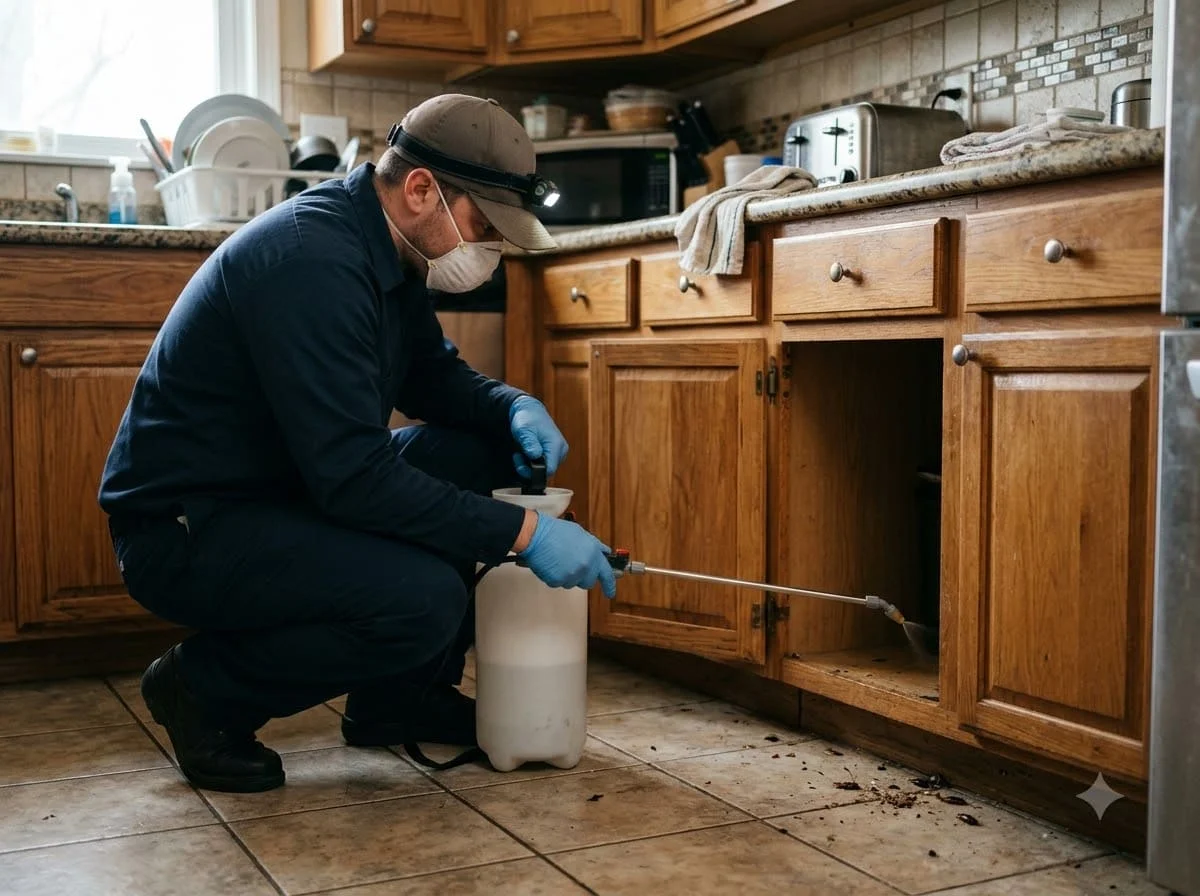
Two very different cockroach problems turn up in Washington, and almost everything about the fix depends on which one you have.
German cockroaches are a permanent indoor resident, concentrated in kitchens, reproducing fast, and — in a connected building — moving between units the way bed bugs do. Oriental cockroaches are a damp basement and crawlspace species that comes in from outside, and they are solved by drying and sealing rather than by baiting.
Get that identification wrong and you can spend several hundred dollars treating a kitchen for an insect that lives under the house.
Telling the two apart
| Species | Where you find it | What it means |
|---|---|---|
| German cockroach | Kitchens and bathrooms. Behind and inside appliances, under sinks, in cabinet hinges and voids. Small, light brown, two dark stripes behind the head. | A resident breeding population indoors. Cannot survive outside in this climate, so it arrived in something — groceries, cardboard, second-hand appliances, or through a shared wall. |
| Oriental cockroach | Damp basements, crawlspaces, drains, foundation edges, under decking. Larger, dark brown to almost black, glossy, slow. | A moisture and access problem. It is living outside or under the building and entering. Drying the space and sealing the route matters more than any spray. |
| American cockroach | Uncommon in Washington homes. Turns up in commercial kitchens, steam tunnels, sewers and large boiler rooms. | Almost always tied to a warm, wet, institutional environment. Where it appears in a home, look at the sewer connection. |
How a German cockroach programme actually runs
Monitoring first. Sticky monitors placed in the suspected harbourage areas tell the technician where the population actually is and give a baseline count to measure against. It is the step most often skipped and the one that makes the difference between three visits and six.
Gel bait, placed in the voids. Modern cockroach control is bait-led. Small placements go into cabinet hinges, appliance motor housings, the void behind a kickboard, and the cracks along a countertop — not onto open surfaces. Roaches feed, return to harbourage, and the active ingredient moves through the population by faeces and cannibalism, which reaches nymphs that never left the void.
An insect growth regulator alongside it. This prevents nymphs reaching reproductive maturity and is what stops the rebound three weeks in. A quote with no IGR component is pricing a knockdown, not an elimination.
Three to four visits. Bait gets consumed and needs replenishing, and the surviving egg cases hatch on their own schedule regardless of what was applied. The follow-up visits are the job, not an upsell, and a company quoting one visit for an established German cockroach population is quoting something that will fail.
Multi-family housing: the same problem as bed bugs
In a connected building, German cockroaches move between units through plumbing chases, electrical runs, shared wall voids and rubbish routes. A treated unit next to an untreated one repopulates within weeks.
The working minimum in any connected structure is the reported unit plus the units either side, above and below. A building with reports in several units needs a coordinated programme with a single schedule, not a sequence of individual callouts spread over months.
For tenants, the relevant Washington law is the same statute that governs bed bugs: RCW 59.18.060 places a duty on most landlords to control infestation, and a written report starts the clock. The Washington landlord and tenant guide covers how notice, the response window and the remedies work — the procedure is identical whichever insect is involved.
For property managers, the apartments and multi-family page covers how building-wide response is structured and documented.
What you control
Cockroaches need food, water and harbourage, and water is the one people underestimate. A German cockroach can persist on very little food but not without moisture, so a dripping trap, a slow leak under a sink or a pet bowl left out overnight matters more than crumbs do.
The practical list is short: fix the leaks, store dry goods and pet food sealed, empty rubbish nightly, clean under and behind appliances where grease accumulates, and remove cardboard storage — corrugated cardboard is close to ideal harbourage and is also how German cockroaches most often arrive in the first place.
For Oriental cockroaches, the list is a building one: lay or repair the crawlspace vapour barrier, clear and re-pitch gutters and downspouts, screen the crawlspace vents, seal the gaps around pipe penetrations, and fit door sweeps. Those same conditions drive moisture ants and wood-rotting fungus, so the work pays for itself more than once.
What it costs in Washington
A German cockroach programme runs $200 to $400 per unit in 2026 across three to four visits, with per-unit cost dropping substantially on a building-wide contract.
Oriental cockroach work is generally cheaper to treat and more expensive to solve, because the durable fix is moisture management and exclusion rather than chemical. The statewide pest control page carries the full cost table across all eight services.